


Research interests and Projects

高能天体物理
High Energy Astrophysics
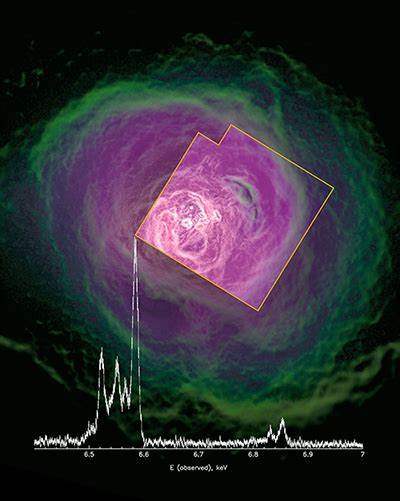
Astrophysical plasmas in the X-ray universe
Warm and hot plasmas can be found in a wide range of astrophysical environments, including but not limited to stellar coronae, supernova remnants, ionized outflows running away from black holes across different mass scales, ionized plamsas around individual galaxies and galaxy assembilies, and cosmic web filaments. The majority of these astrophysical plasmas are observable in the X-ray band, especially via characteristic emission and/or absorption features. Observationally, high-resolution X-ray spectroscopy (grating and microcalorimeter) is the key to probe the physics behind the observed viriaty. Theoretically, atomic data, plasmas models, and diagnostic tools are essential to interpret the observed spectra.
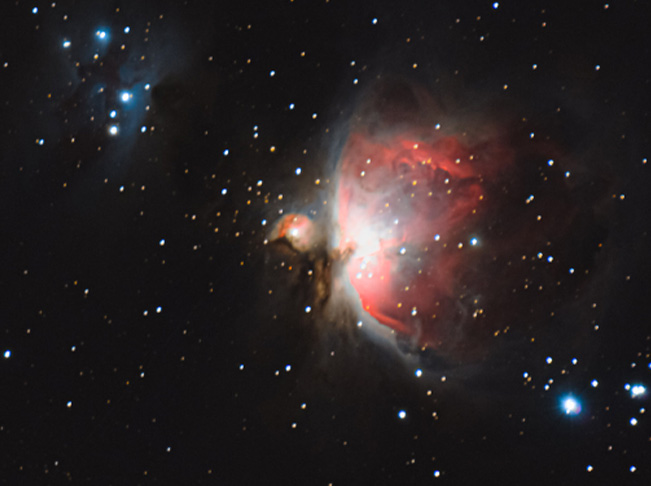
Compact objects
Usually refer to astronomical systems containing black holes, neutron stars, or white dwarfs. As some of the brightest sources of X-rays, gamma-rays, and radio emissions, they play an important role in high-energy astrophysics.
Our group investigates the physics of compact objects through a combination of observations and theoretical modeling. Key research directions include:
· Extreme Transient Phenomena: Exploring the physical mechanisms behind transients such as magnetar bursts, kilonovae, and tidal disruption events.
· Magnetars: Modeling highly magnetized neutron stars, to understand their structure, radiation, and evolution.
· Binary Evolution: Investigating neutron stars in binary systems and their magnetized environments to uncover the formation and evolutionary pathways of binaries.
· Fast Radio Bursts: Studying these newly discovered intense radio transients, which serve as important probes of extreme, highly magnetized compact objects in the early universe.
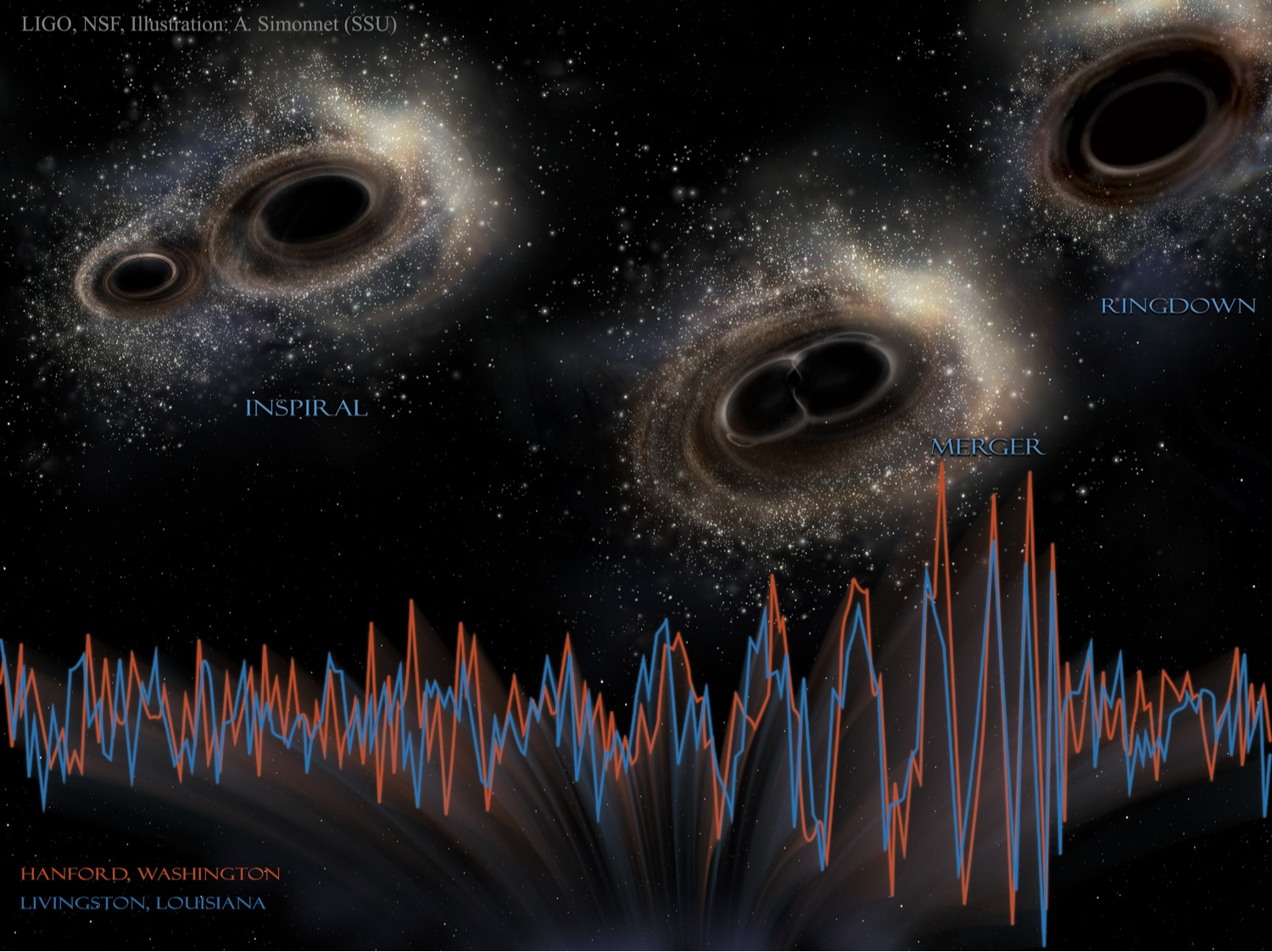
Gravitational-Wave Physics
A wide range of physical processes in the Universe—such as the dynamics of compact objects, supernova explosions, and even cosmic inflation and phase transitions in the early Universe—can generate characteristic gravitational-wave radiation. These signals are often influenced by their astrophysical environments, including accretion disks, dark matter, and nearby stars. Our research focuses on developing theoretical models and corresponding data analysis techniques to use gravitational-wave observations to probe the fundamental properties, formation channels, population distributions, and environmental physics of their sources. We also study sources that can be observed through multiple messengers, including gravitational waves, electromagnetic signals, and neutrinos. Such multi-messenger astronomy, by combining complementary information, offers exceptional opportunities for major scientific discoveries.

Cosmic-ray Astrophysics
Cosmic-rays are energetic charged particles that prevail the universe. They are the outcome of extreme (i.e., eruptive and explosive) astrophysical phenomena, can reach energies well beyond those achievable on Earth, and have profound influences to the evolution of galaxies and beyond. How does the universe manage to efficiently accelerate particles to such extreme energies? How do such particles propagate and escape? What are the essential microphysical processes behind cosmic-ray feedback? In Tsinghua, we address these fundamental questions by carrying out detailed simulations from first principles.