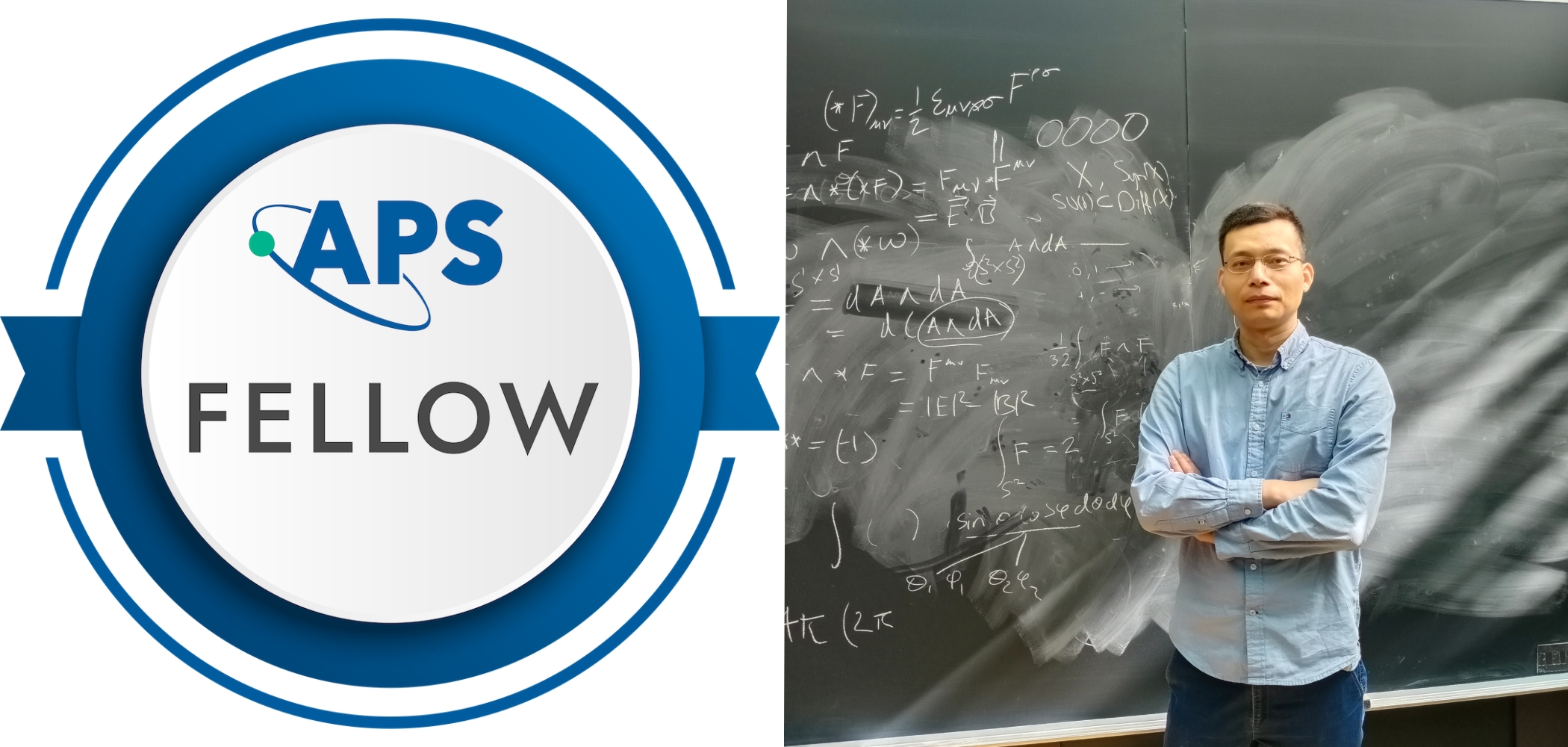
On October 9, 2026, the American Physical Society (APS) announced its newly elected Fellows for 2026. Huan Yang, a tenured associate professor in the Department of Astronomy at Tsinghua University, was elected with the citation: “For broad contributions to gravitational theory, astrophysics, and gravitational-wave science, and for leadership in advancing innovative research across disciplines.”
Professor Yang has made a series of significant contributions to black-hole perturbation theory, which describes how black-hole spacetimes respond to disturbances and undergo ringdown, the final stage of a black-hole merger, when the newly formed black hole settles into a steady state. This theory provides a key framework for understanding the physics of strong gravitational fields and for modeling and analyzing gravitational-wave signals from black-hole mergers. Yang has greatly advanced this framework, particularly through important contributions in nonlinear black-hole perturbation theory. Their work has revealed the physical properties of nonlinear black-hole ringdown modes, providing a theoretical foundation for investigating post-merger black-hole dynamics and testing general relativity through gravitational waves studies.
Yang has also made widely recognized contributions to research on the dynamics, formation mechanisms, and environmental effects of gravitational-wave sources. In particular, in the study of extreme mass-ratio inspirals, he and his collaborators discovered a new “tidal resonance” phenomenon, developed theoretical models for the formation and evolution of these systems in active galactic nuclei, and investigated how surrounding environments, including dark matter, affect their orbital evolution and gravitational-wave signals. These studies have deepened our understanding of compact-object dynamics in strong gravitational fields and provided theoretical support for future space-based gravitational-wave observations and related astrophysical research.
In addition, Yang has actively advanced research on next-generation ground-based gravitational-wave detectors targeting the kilohertz frequency band. Together with his collaborators, he has proposed concepts for detecting the high-frequency gravitational-wave signals emitted after binary neutron star mergers and led studies of the associated scientific objectives and detector designs. These contributions have contributed to optimize high-frequency sensitivity and develop the scientific priorities of next-generation ground-based gravitational-wave detectors.
Yang received his bachelor’s degree from the California Institute of Technology in 2007 and his PhD from the same institution in 2013. He subsequently held postdoctoral positions at the Perimeter Institute for Theoretical Physics in Canada and Princeton University in the United States. From 2017 to 2024, he served as an associate professor at the University of Guelph in Canada and as an associate faculty member at the Perimeter Institute. He joined the Department of Astronomy at Tsinghua University in April 2024 as a tenured associate professor. He is a member of the LISA Consortium and the LIGO Scientific Collaboration, which pursue space-based and ground-based gravitational-wave detection, respectively.
About APS
Founded in 1899, the American Physical Society (APS) is one of the most prestigious and influential professional physics organizations in the world, with the mission to "advance and diffuse the knowledge of physics." APS elects new Fellows annually as the highest honor bestowed upon members for exceptional research, innovation, education, and leadership. The number of elected Fellows is limited to at most half a percent of its total membership (excluding students). APS publishes world-renowned physics research journals, including Physical Review Letters, Physical Review, and Reviews of Modern Physics.


