Beyond the Milky Way, the vast universe is filled with hundreds of millions of galaxies in a variety of shapes. Some unfold in spirals; others are compact and clumpy, and still others have irregular forms. These different morphologies and structures not only trace the motions, accumulation, and interactions of stars, gas, and dark matter, but also preserve clues to the long histories of galaxy evolution.
Among them, barred spiral galaxies are a distinctive yet common class of disk galaxies. They feature extended galactic disks, spiral arms, and an elongated ‘bar’ crossing the central region. The Milky Way is a familiar example. Barred spiral galaxies are quite common in today’s universe: near-infrared observations suggest that roughly 60% of disk galaxies host bars. The presence of a bar often indicates that a galaxy has developed an ordered, stable stellar disk supported by rotation. Bars can also redistribute angular momentum and drive gas flows within galaxies. These processes influence star formation in the central regions and throughout the disk, playing an important role in the galaxy’s long-term structural evolution.
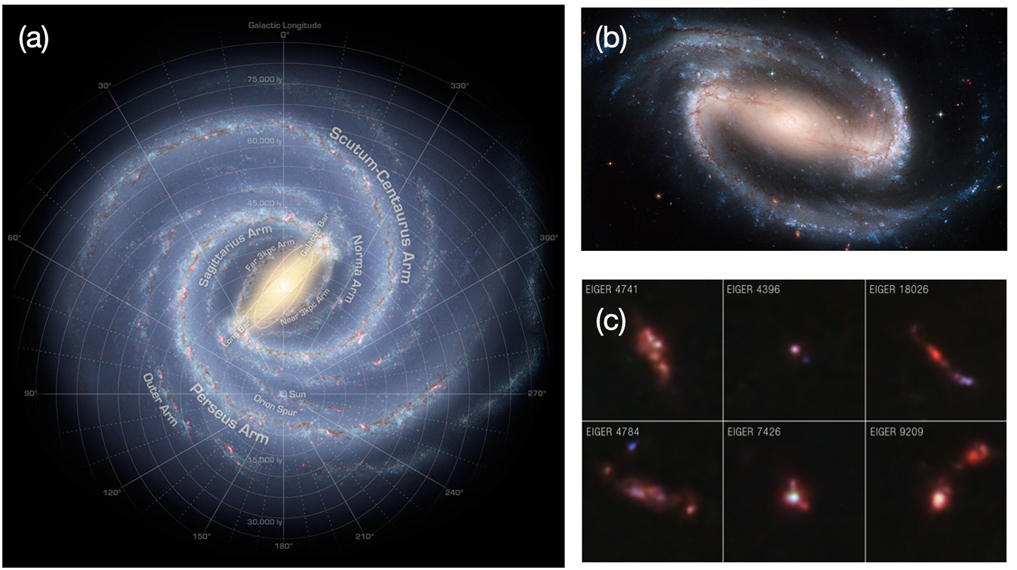
Figure 1 | Examples of galaxy morphologies across different cosmic epochs. (a) An illustration of the structure of the Milky Way. Credit: NASA/JPL-Caltech/R. Hurt (SSC/Caltech). (b) NGC 1300, a typical barred spiral galaxy in the nearby universe. Credit: NASA, ESA, and the Hubble Heritage Team (STScI/AURA); acknowledgment: P. Knezek (WIYN). (c) A group of high-redshift galaxies observed by JWST in the field of quasar J0100+2802. Credit: NASA, ESA, CSA, Simon Lilly (ETH Zurich), Daichi Kashino (Nagoya University), Jorryt Matthee (ETH Zurich), Christina Eilers (MIT), Rongmon Bordoloi (NCSU), Ruari Mackenzie (ETH Zurich); image processing: Alyssa Pagan (STScI), Ruari Mackenzie (ETH Zurich).
The distant early universe, however, was a very different environment. Galaxies were growing rapidly, with frequent collisions, mergers, and interactions. Intense star formation and feedback gave rise to compact, clumpy, and irregular galaxies, while the barred spiral morphology associated with dynamically settled disks was thought to be rare. In such a chaotic cosmic environment, bars are difficult to form and grow. Both observations and simulations have supported this picture: galactic bars appear increasingly rare as we look further back in cosmic time.
However, recent observations with the James Webb Space Telescope (JWST) have begun to challenge this picture. With its greater sensitivity, finer angular resolution, and coverage of longer wavelengths, JWST has revealed an increasing number of galaxies with extended disks in the early universe. Some even display well-defined spiral arms and prominent bars. Statistical studies suggest that the fraction of barred galaxies identified with JWST can be up to twice that found with the Hubble Space Telescope. JWST has also revealed barred galaxies at earlier cosmic epochs than previously observed. These findings raise two important questions: When did bar spiral structures first emerge, and how could they form and grow in the turbulent early universe?
Recently, a research team from Tsinghua University, Westlake University, and other institutions in China and abroad identified a massive barred spiral galaxy candidate, M1149-BSG-z5, at a redshift of z = 5.102 using JWST observations. The galaxy was initially detected in deep JWST imaging data, and its redshift was subsequently confirmed through spectroscopy with JWST’s Near-Infrared Spectrograph (NIRSpec). It is the highest-redshift, and thus earliest, barred galaxy candidate known to date. We see M1149-BSG-z5 as it was about 12.6 billion years ago, when the universe was only 1.1 billion years old. It is the first known barred spiral galaxy candidate beyond redshift 5, suggesting that such complex structures may have emerged remarkably early in cosmic history.
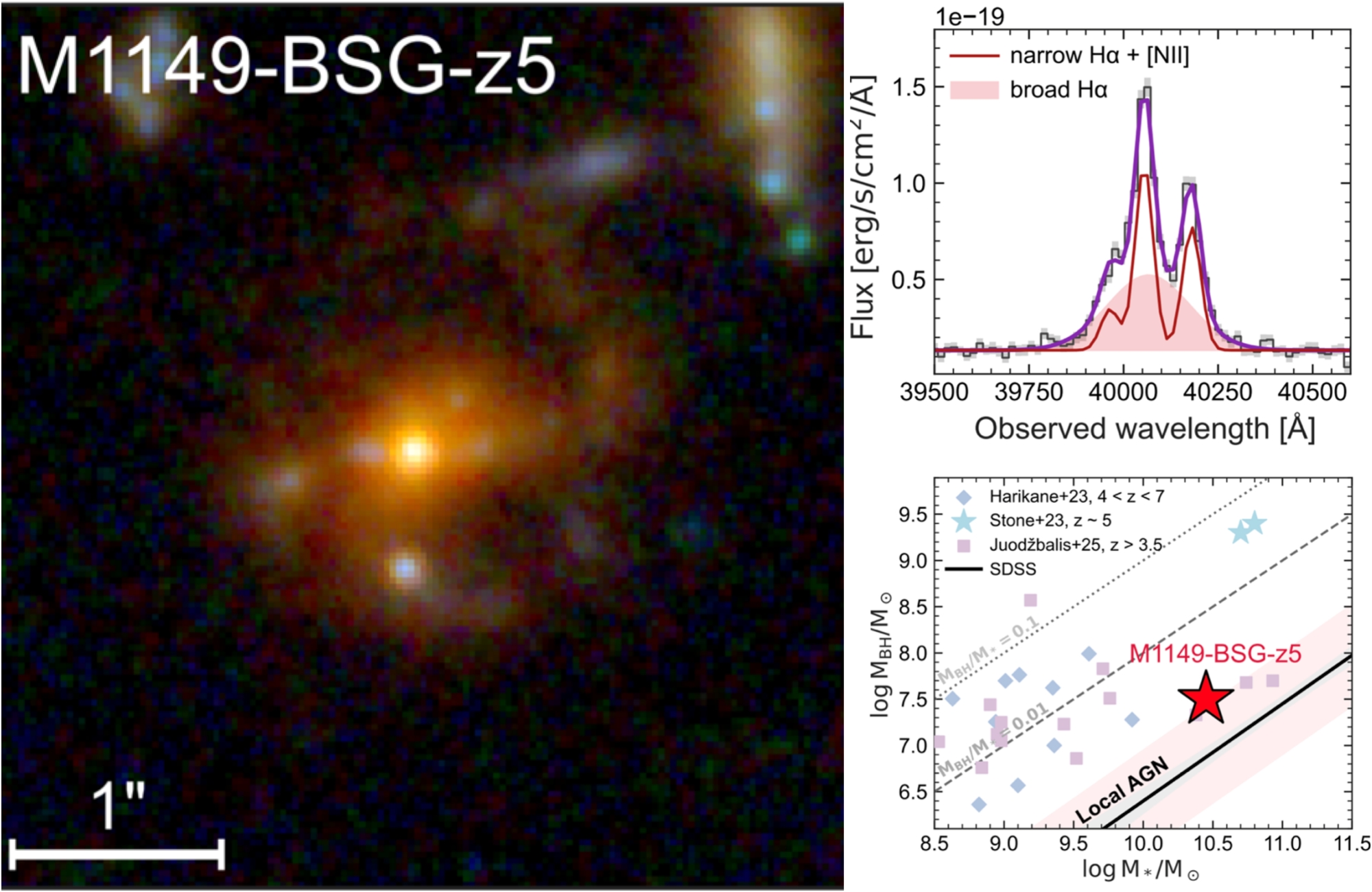
Figure 2 | M1149-BSG-z5 observed by JWST. Left: The galaxy, at redshift z = 5.102, exhibits a prominent central bar and outward-extending spiral arms. It is currently the highest-redshift and earliest-known barred galaxy candidate. Right: The actively accreting supermassive black hole at the center of M1149-BSG-z5. Top: The Hα + [N II] spectrum obtained with JWST/NIRSpec. A distinct broad component in the Hα emission line indicates the presence of an actively accreting supermassive black hole at the galaxy center. Bottom: The relationship between black hole mass and host-galaxy stellar mass. The red star marks M1149-BSG-z5, whose black hole has a mass of approximately 30 million solar masses and a black-hole-to-stellar-mass ratio of about one thousandth, approaching the relation observed for active galactic nuclei in the nearby universe. Image credit: Wang et al. (2026).
Further analysis shows that M1149-BSG-z5 already exhibited signs of substantial evolution and maturity when the universe was only about 1.1 billion years old. Its stellar mass is estimated at approximately 28 billion times that of the Sun, comparable to the stellar mass of the Milky Way. Spectroscopic observations also reveal an actively accreting supermassive black hole at the galaxy center. The black hole has an estimated mass of 30 million solar masses, about one thousandth of the galaxy's stellar mass. This ratio is like that observed in nearby galaxies hosting active galactic nuclei. Meanwhile, the abundance of heavy elements in the galaxy gas has already reached about half the solar value, indicating substantial star formation and chemical evolution at this early epoch. The researchers also found that M1149-BSG-z5 lies in a relatively dense galactic environment, where interactions between galaxies may have helped trigger the formation of its bar. In addition, the galaxy itself may have been rich in gas and had a relatively high baryonic fraction, making its disk more susceptible to gravitational instability and thereby accelerating bar formation.
The discovery of M1149-BSG-z5 pushes the observational boundary for barred spiral galaxy candidates back to just 1.1 billion years after the Big Bang. It suggests that some massive galaxies may have rapidly assembled their mass and developed complex structures—including disks, bars, and spiral arms resembling those seen in present-day barred spiral galaxies such as the Milky Way—at a stage when the universe was previously considered very ‘young.’ The findings provide new observational constraints on the emergence of galactic disks and the formation of bars in the early universe, as well as on the links between bars, gas transport, star formation, and the growth of central black holes. They also challenge existing models of high-redshift galaxy formation and dynamical evolution.
This study, titled “A massive barred spiral galaxy at z = 5.102 discovered by JWST,” was published in The Astrophysical Journal (ApJ). The first author is Xiaohan Wang, who earned a PhD from the Department of Astronomy at Tsinghua University and is now a postdoctoral researcher at Westlake University. Xiaohan Wang and Fengwu Sun of Westlake University are the corresponding authors. The research team also includes Professor Shude Mao of Westlake University; Professor Zheng Cai of Tsinghua University’s Department of Astronomy; and Tsinghua University doctoral students Xiaojing Lin, Mingyu Li, and Sijia Cai. Collaborating institutions include the Center for Astrophysics | Harvard & Smithsonian, the University of Toronto, and the University of Tokyo, among others. The work was supported by the National Natural Science Foundation of China and other funding sources.
Original paper: https://iopscience.iop.org/article/10.3847/1538-4357/aea414


