In 1979, astronomer Carl Heiles identified giant shells of neutral hydrogen in the Milky Way, some of them expanding across hundreds or thousands of light-years. The largest shell required more energy than a single supernova could supply. Such structures, known as superbubbles, can be formed by stellar winds and repeated supernova explosions.
Superbubbles may also help answer a longstanding question: what sustains turbulence, the irregular gas motions that influence star formation? Turbulence continuously loses energy, but the fraction of supernova energy transferred to the gas has been difficult to determine.
A team led by Professor Di Li at Tsinghua University has now used superbubbles in the Andromeda galaxy to show that successive supernova explosions can supply enough energy to sustain the observed turbulence in its neutral hydrogen gas.
Andromeda, also known as M31, lies about 2.5 million light-years away and offers an external view of an entire galactic disk. The team combined observations from China’s FAST radio telescope and the Karl G. Jansky Very Large Array (JVLA) in the United States, capturing both diffuse gas and fine shell structure. This revealed 118 expanding superbubbles, including slowly expanding structures with estimated ages of up to 40 million years.
The observations provided the shells’ sizes, expansion speeds, and surrounding gas densities. Together, these measurements allowed the team to estimate both the kinetic energy transferred to the gas and the duration of the input, yielding its average rate. This replaces an assumed energy-transfer efficiency with an estimate based on the gas itself.
In addition, the researchers estimated how quickly turbulence loses energy, accounting for galactic rotation and thermal motions. The input and loss rates agreed in magnitude and in their variation with distance from the galaxy’s center. The match provides direct quantitative evidence that clustered supernovae can maintain M31’s neutral-hydrogen turbulence.
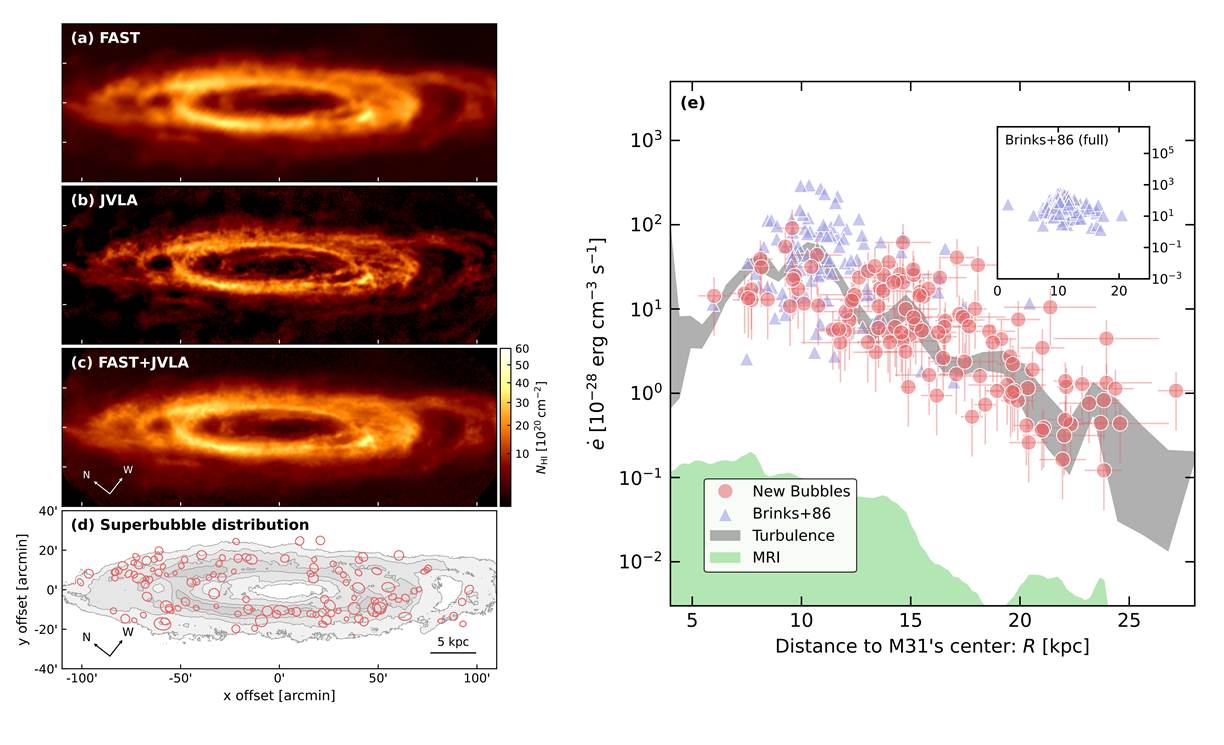
Figure | Atomic hydrogen superbubbles and the turbulent energy budget in the Andromeda galaxy. (a–c) Atomic hydrogen maps from FAST, JVLA, and their combination. (d) Red ellipses mark 118 expanding superbubbles over gray contours of atomic hydrogen emission. (e) Superbubble energy injection rates (red circles) match turbulent dissipation rates (gray band) in magnitude and radial trend. Green shading shows the estimated contribution from magnetorotational instability. Blue triangles show an earlier bubble sample, with its full range in the inset.
The study, “Supernova origin of galactic turbulence revealed by superbubbles,” was published online in Nature Astronomy on September 17, 2026.
The research was led by Di Li’s team in Tsinghua University’s Department of Astronomy, with the National Astronomical Observatories of the Chinese Academy of Sciences and international collaborators. Tsinghua is the first-listed affiliation. Fanyi Meng of Tsinghua and Chao-Wei Tsai and Jingwen Wu of the National Astronomical Observatories share first authorship; Di Li is the corresponding author. Funding came from the National Natural Science Foundation of China, the New Cornerstone Science Foundation, and other sources.


