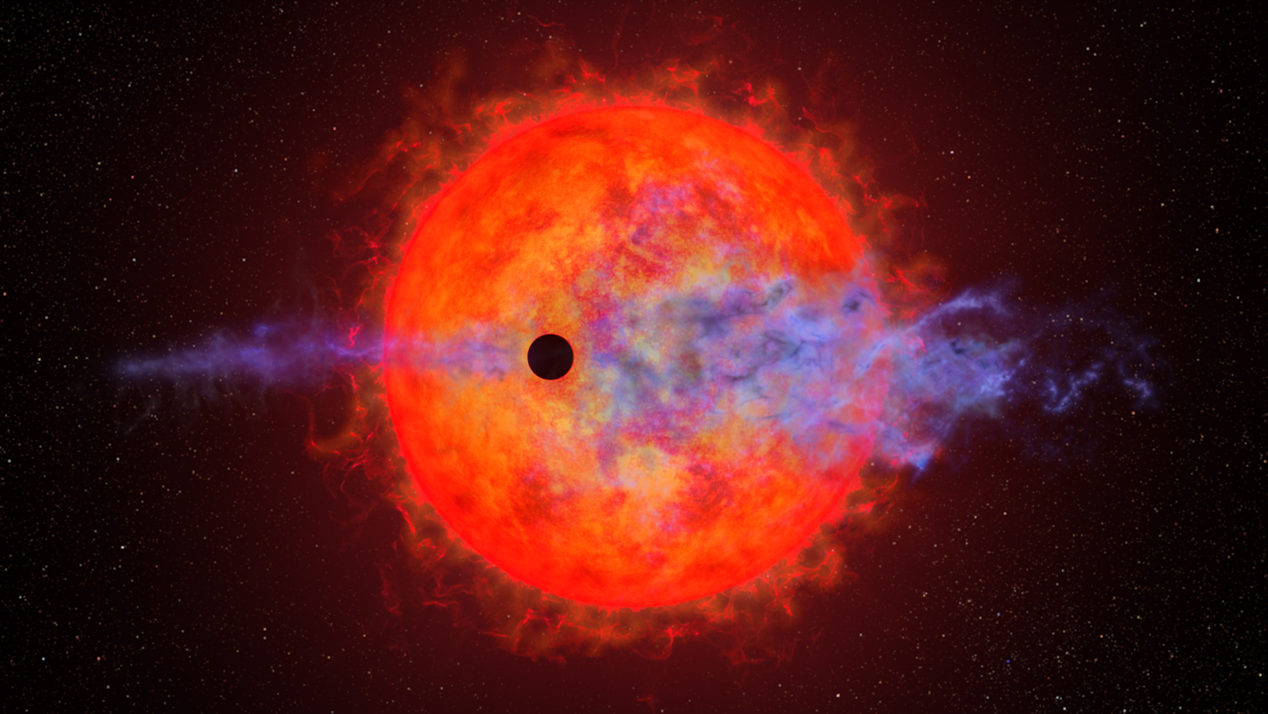
In a recent study led by the Department of Astronomy at Tsinghua University, astronomers measured the spin–orbit architecture of two planets in the young planetary system AU Mic.
Whether or not a planet’s orbit is aligned with the rotation of its host star provides an important clue to understanding the formation and history of planetary systems. In the Solar System, planet orbits are mostly aligned with the Sun’s equatorial plane. However, in exoplanetary systems, astronomers have discovered many planets with tilted or even retrograde orbits. Whether these tilts originate from the protoplanetary disk during the early stages of planet formation, or are instead caused by later dynamical processes such as planet–planet interactions, remains a key question in exoplanet research.
Young planetary systems offer a unique window into this question. Because they formed relatively recently and have not yet undergone long-term dynamical evolution, their orbital architectures are more likely to preserve information from the early stages of planet formation. AU Mic is such a valuable target: located at just 9.8 parsecs (about 32 light-years) from Earth, it is approximately 20 million years old and hosts a young M-dwarf star, two Neptune-sized transiting planets, AU Mic b and c, and a debris disk. It is therefore a benchmark system for studying the early architecture of planetary systems.
In this study, the team took advantage of a rare opportunity on August 24–25, 2024, when both AU Mic b and c transited their host star on two consecutive nights. The observations were carried out with the Planet Finder Spectrograph (PFS) on the Magellan Telescope, together with simultaneous observations from the CHEOPS space telescope and the ground-based LCOGT telescope network. By observing the Rossiter–McLaughlin effect —the radial-velocity anomaly that arises when a transiting planet blocks different regions of a rotating stellar surface—the team measured the sky-projected angles between the planetary orbits and the stellar spin axis. This “back-to-back” observing window allowed the team to directly compare the orbital architectures of the two planets under similar stellar activity conditions using the same high-precision instrument.
The results confirm that the orbit of AU Mic b is aligned with the stellar rotation, with a sky-projected spin–orbit angle of about 1 degree and an uncertainty of about 12 degrees, consistent with previous independent measurements. For AU Mic c, the team found two possible orbital solutions: one in which the planet is approximately aligned with the stellar rotation, with a projected angle of about −10 degrees and an uncertainty of about 16 degrees; and another in which the planet follows a nearly polar orbit, passing over the stellar poles during each orbit, with a projected angle of about 87 degrees. Taking into account factors such as dynamical stability and the probability of observing transits, the overall results strongly support a mutually aligned configuration, in which the orbits of the AU Mic b and c are aligned with the host star’s spin and the debris disk, an ordered configuration akin to the solar system.
At the same time, the strong and complex stellar activity of AU Mic posed significant challenges for the measurements. The study found that short-timescale stellar activity signals can substantially affect both the light curves and radial-velocity data, and may even mimic or interfere with the Rossiter–McLaughlin effect observed during planetary transits. This result highlights the importance of understanding stellar activity itself when studying planets around young and active stars. In the future, new simultaneous multiwavelength observations obtained during quieter stellar activity windows, or more effective methods for modeling stellar activity, may ultimately help clarify the true three-dimensional architecture of the AU Mic system.
This study has been published in The Astrophysical Journal Letters and was led by Zitao Lin, a PhD student in the Department of Astronomy at Tsinghua University. Assistant Professor Zhen Guo of the University of Valparaíso and Associate Professor Sharon X. Wang of the Department of Astronomy at Tsinghua University serve as co-corresponding authors. The research team includes PhD students Jiayin Li and Zhecheng Hu from Tsinghua University and members from the Chinese Academy of Sciences South America Center for Astronomy, ELTE Gothard Astrophysical Observatory in Hungary, the University of Valparaíso, the Carnegie Institution for Science, and many other institutions in China and abroad. This work was supported by the China–Chile Joint Research Fund, the Chinese Academy of Sciences South America Center for Astronomy (CASSACA) Key Research Project, the National Research and Development Agency (ANID), the National Natural Science Foundation of China (NSFC), and other programs and institutions.


