Summary: Astronomers have identified DART J1832-0911, a radio source that flashes every 44.27 minutes from inside the supernova remnant G22.7-0.2. As DART's first astronomical discovery, the source was found with DART and followed up by FAST, which detected a nearly 100% linearly polarized pulse, supporting the idea that the object is most likely a young neutron star slowed by materials left over from its preceding supernova explosion.
Every 44 minutes, a faint radio beacon turns on inside the remains of an exploded star.
Prof. Di Li and collaborators have reported DART J1832-0911, a long-period radio transient embedded in the supernova remnant G22.7-0.2. Published in Science Bulletin, the discovery provides strong evidence that some ultra-slow radio flashes (known as Long Period Transients, a.k.a. LPTs) are connected to compact stellar remnants left behind by supernova explosions.
DART consists of 313 six-meter dishes arranged in a 1 km-diameter ring. In 2023 the DART team noted that an effective aperture of about one kilometer was best-suited for tracking solar radio bursts and to improve space-weather forecasting. The detection of DART J1832−0911, the first astronomical discovery made by DART, demonstrates DART’s unique capability to distinguish faint and intermittent signals from the crowded Galactic background.
The source was first identified as an intermittent radio transient in DART monitoring observations. Follow-up observations over the following weeks enabled the arrival times of individual bursts to be measured, revealing a stable periodicity of 2656.23 +/- 0.15 s (44.27 min). Such long-period radio transients are puzzling because ordinary pulsars usually spin much faster, while white-dwarf models cannot easily explain isolated sources. The position of DART J1832-0911 inside a known supernova remnant therefore offers rare clues to what the nature of these slow cosmic flashes could be. Multiple lines of evidence support the sources’ association with G22.7-0.2, including dispersion measure, CO and HI absorption, and the unlikely probability of a chance-alignment. Following the discovery, FAST provided the decisive piece of evidence, a short pulse from the source that was 100% linearly polarized, pointing to an ordered magneto-ionic environment surrounding the source.
Thus, the study suggests that DART J1832-0911 is most likely a young neutron star whose spin was slowed by material falling back from the earlier supernova explosion. This scenario offers a possible explanation for how a neutron star born spinning rapidly could slow to the observed 44-minute rotation period while still producing bright radio flashes.
Further direct distance measurements, such as very long baseline interferometry, will be needed to test the association more firmly. Even so, DART J1832-0911 already combines two lines of evidence - a source embedded in a supernova remnant and a nearly 100% linearly polarized FAST pulse - offering a new path for understanding ultra-slow radio transients.
The first author of this study is Prof. Di Li of the Department of Astronomy at Tsinghua University. The corresponding author is Prof. Jingye Yan, a researcher at the National Space Science Center, Chinese Academy of Sciences, who also serves as the Principal Investigator of the Daocheng Radio Telescope (DART), a National Major Science and Technology Infrastructure of China.
Digital Object Identifier (DOI)
https://doi.org/10.1016/j.scib.2026.06.015
Related Journal Name
Science Bulletin
Original Source URL
https://doi.org/10.1016/j.scib.2026.06.015
Method of Research
Observational study
Keywords
Astronomy; Physics; Observational studies; Long-period radio transients; Neutron stars; Pulsars; Supernova remnants; Radio astronomy
Multimedia
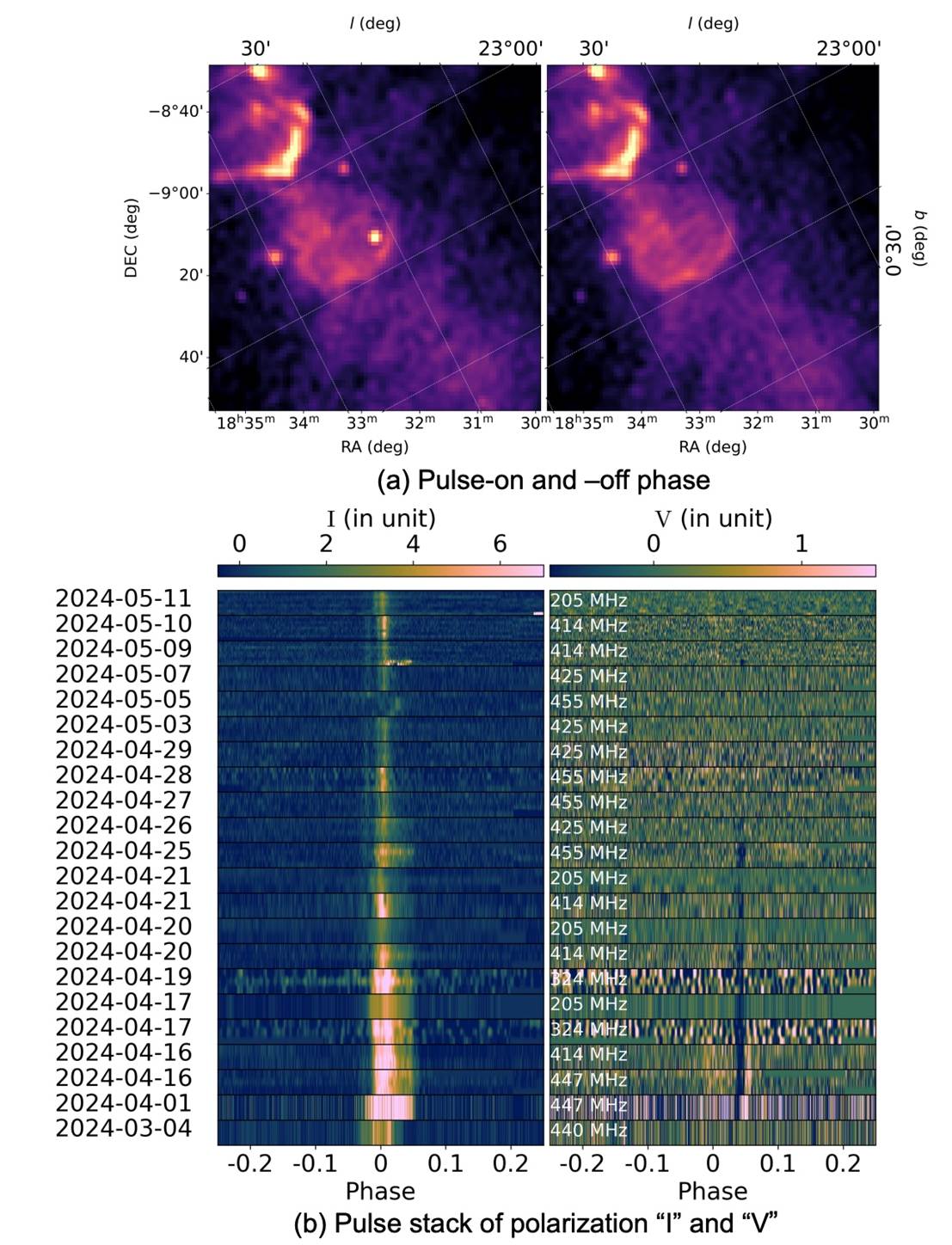
Title - DART observations of DART J1832−0911
Caption - DART observations of DART J1832−0911. The upper panels compare radio images obtained during the pulse-on and pulse-off phases, showing the source within the projected extent of the supernova remnant G22.7−0.2. The lower panels show pulse stacks from multiple observing epochs in total intensity (Stokes I) and circular polarization (Stokes V).
Media - `figures/1.jpg
Credit - © Science China Press
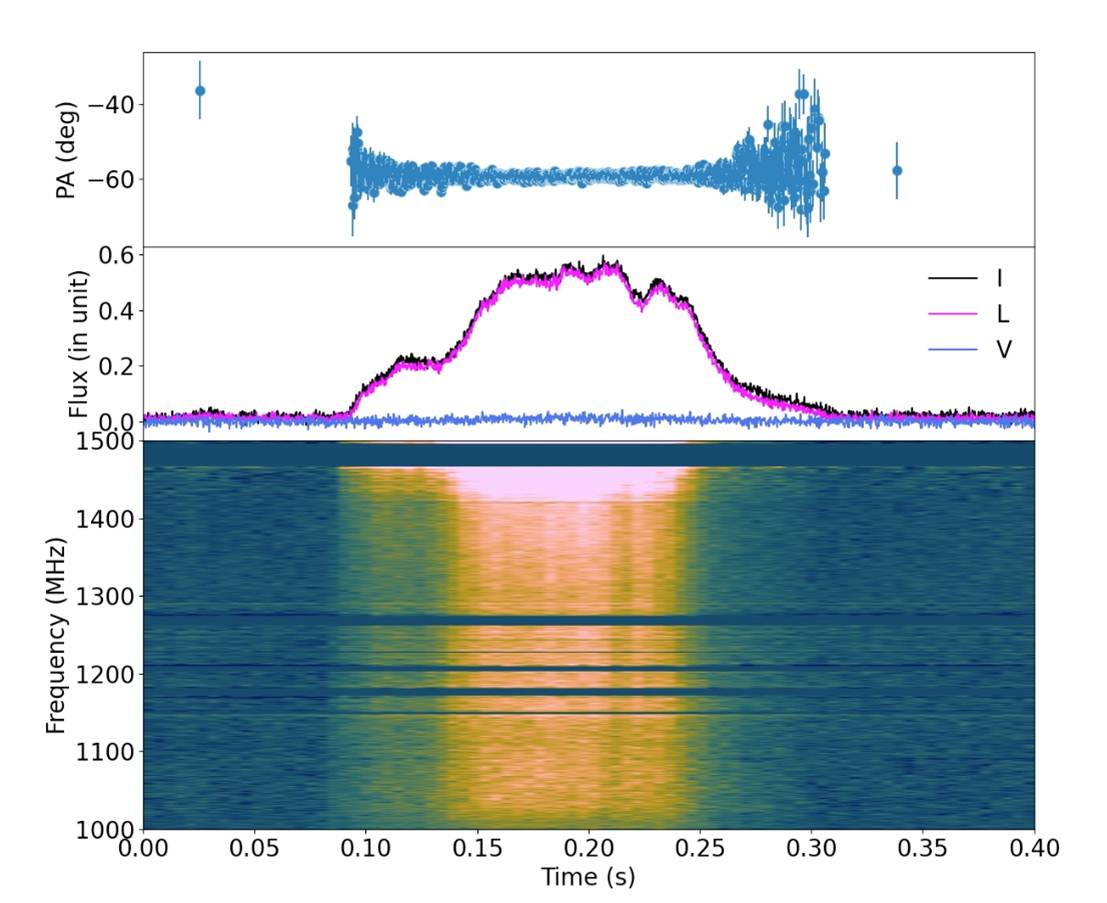
Title - FAST detects a 0.2-second pulse from DART J1832−0911
Caption - FAST detected a single 0.2-second pulse from DART J1832−0911 during a DART radio-quiet interval. The bottom panel shows the pulse as a bright broadband feature in the dynamic spectrum, while the upper panels display its polarization position angle and pulse profiles in total intensity (I), linear polarization (L), and circular polarization (V).
Media - `figures/2.jpg
Credit - © Science China Press


