For decades, one class of neutron stars refused to speak in radio waves.
An international research team led by Prof. Di Li of the Department of Astronomy at Tsinghua University has detected radio pulsations from the Central Compact Object (CCO) 1E 1207.4−5209, a young neutron star embedded in the supernova remnant PKS 1209−51/52. Published in Nature Astronomy, the discovery provides some of the strongest evidence to date that CCOs, long thought to be radio-silent, are connected to the broader pulsar population and may represent an extremely radio-faint stage of neutron star evolution.
Since the discovery of pulsars in 1967, neutron stars have become one of the most important laboratories for studying extreme physics. Yet among the known neutron star population, CCOs have remained particularly mysterious. Located at the centers of supernova remnants, CCOs are bright thermal X-ray sources and exhibit many characteristics of young neutron stars. However, repeated searches over the past two decades failed to detect radio pulsations from any CCO, leading to the widespread view that CCOs might be intrinsically radio silent.
The new study provides the first clear answer.
Using the MeerKAT radio telescope array in South Africa, a precursor facility to the Square Kilometre Array (SKA), the team conducted deep searches of several CCOs. The team detected a faint radio pulsar with a 424 milliseconds period corresponding to the archetypal CCO 1E 1207.4−5209, which is located at the center of the supernova remnant PKS 1209−51/52.
In composite images combining MeerKAT radio observations and eROSITA X-ray observations, this neutron star embedded within its natal supernova remnant mimics a blue eye. The discovery team thus nicknamed it the “Blue Eye Pulsar”.
The detection was enabled by both the exceptional sensitivity of MeerKAT and a carefully tailored observing strategy. By combining deep targeted observations with advanced signal-processing techniques, the team was able to identify an extraordinarily faint signal that had remained hidden for decades. In 2015, the neutron star also experienced a significant glitch—a sudden change in its spin period. The researchers speculate that this event may have altered the star’s magnetic environment and activated its radio emission. Continued observations will be required to test this hypothesis.
This discovery establishes, for the first time observationally, a direct link between CCOs and ordinary radio pulsars, challenging the traditional view that CCOs are intrinsically radio silent. The results show that even young neutron stars with relatively weak magnetic fields can produce pulsed radio emission, and suggest that the Milky Way may host a large hidden population of faint young pulsars. When their natal supernova remnants disperse, these pulsars are at risk to be mislabeled as ‘old’ normal pulsars.
Previous studies have shown that this CCO exhibits the most distinctive X-ray absorption lines among neutron stars, providing a unique probe of the neutron star’s magnetic field. The “Blue Eye Pulsar” now makes it possible to connect the radio-emission region, X-ray-emission region, and absorption-line-forming region within a unified framework, offering a new route to understanding the structure and evolution of neutron-star magnetospheres.
This discovery demonstrates the power of next-generation, high-sensitivity radio telescopes such as MeerKAT to uncover hidden objects in the Universe. With MeerKAT, FAST, and the future SKA coming online, astronomers are expected to discover more such sources, further refining our picture of neutron stars as extreme astrophysical laboratories.
The study was led by Prof. Di Li, the director of the Department of Astronomy at Tsinghua University and affiliated with the National Astronomical Observatories of the Chinese Academy of Sciences (NAOC), who is the sole corresponding author of the paper. Dr. Lei Zhang of the NAOC is the paper’s first author. The international research team also brought together astronomers from Germany, Australia, the United States, Canada, and other countries. Prof. Matthew Bailes, who served as a Distinguished Visiting Professor in the Department of Astronomy at Tsinghua University during the project, was also a member of the team.
The article is available at: https://www.nature.com/articles/s41550-026-02899-2.
Related coverage by CCTV is available here: https://content-static.cctvnews.cctv.com/snow-book/index.html?item_id=18351474837917800520
and by China Daily: https://enapp.chinadaily.com.cn/a/202606/30/AP6a43c069a3108d4743bbe12a.html
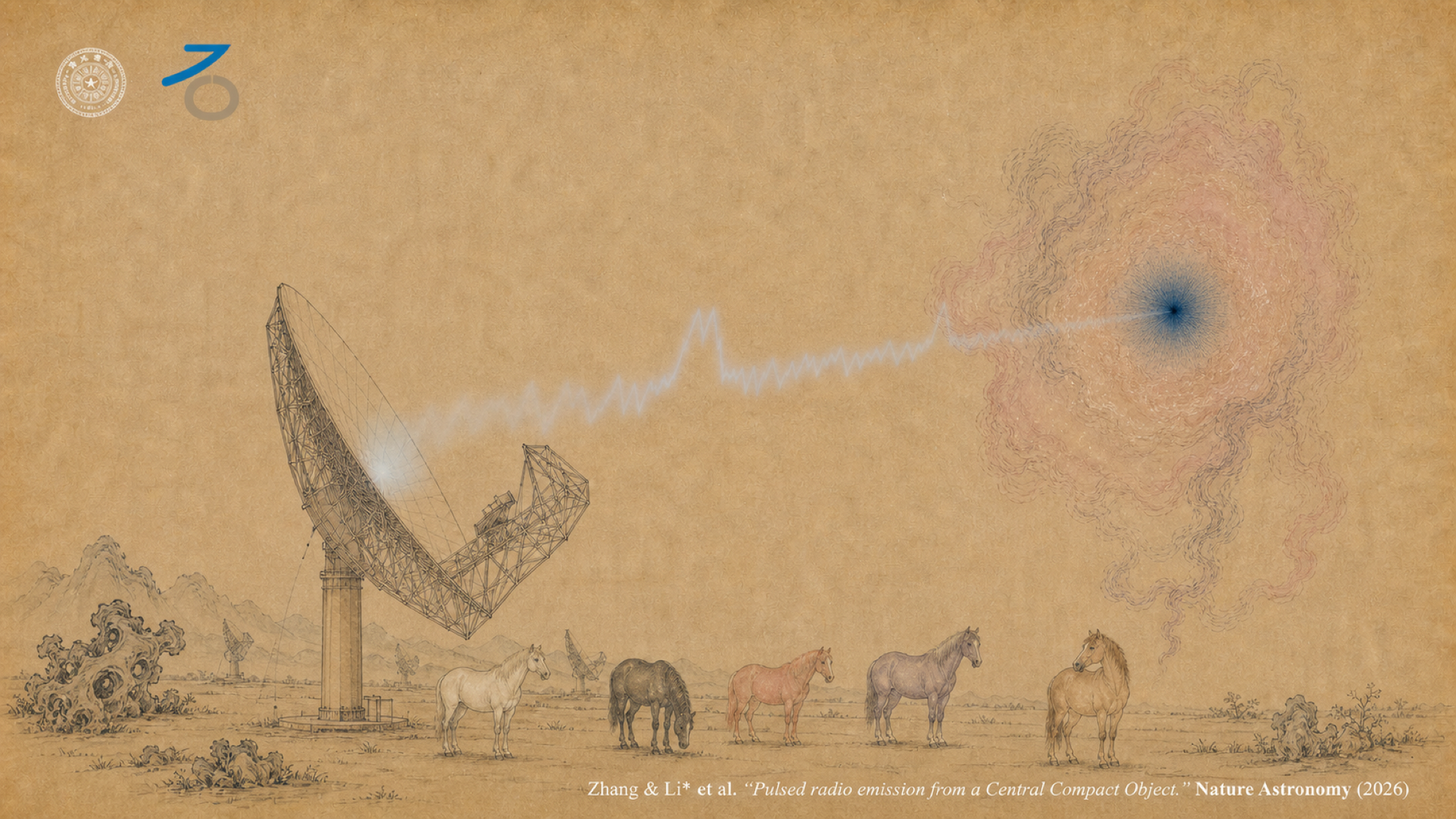
Fig. The blue-eye pulsar presented in the style of classic painting Five Horses from the Song dynasty, back to which the first complete human record of a supernova explosion dates. The horses here symbol the fusion of art and space exploration and signify the legacy of astronomical discoveries in human civilization.


