Recently, Professor Xuening Bai at the Institute for Advanced Study and Department of Astronomy at Tsinghua University published a review article which systematically reviewed the physical mechanisms behind angular momentum transport and long-term evolution of protoplanetary disks, and discussed future prospects on the study of protoplanetary disk gas dynamics and planet formation.
Protoplanetary disks are dust-rich gaseous disks surrounding newly formed stars. With typical lifetimes of a few million years, planets form in protoplanetary disks. Planet formation strongly depends on disk physical conditions, especially disk structure and its evolution, which are the consequences of disk angular momentum transport.
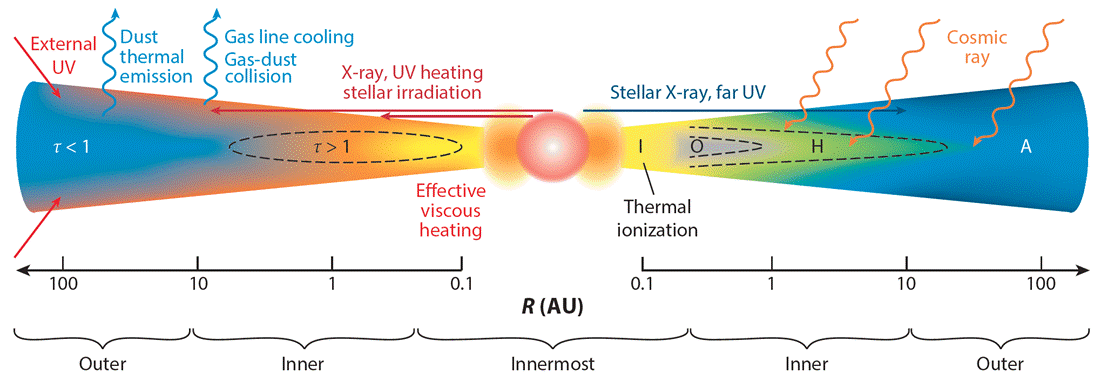
Figure 1:Division into three regions in protoplanetary disks according to disk microphysics.
In the article, founded upon research over the past two decades, Prof. Xuening Bai proposed a hierarchical framework for understanding physical processes in protoplanetary disks:
- Microphysics: Processes acting at atomic and molecular levels that set the coupling among gas, magnetic fields and radiation (Figure 1).
- Gas dynamical processes: isolated fluid-level processes as a result of specific microphysics, including a number of fluid instabilities and disk outflows.
- Full disk applications: incorporate the full complexity toward realistic scenarios, where multiple processes act concurrently.
The article provides a systematic review at each of the three levels. At the top level, it is recognized that the bulk disk exhibits weak turbulence, with magnetically-driven wind likely serving as the primary transport mechanism. This is also by and large supported by observations. However, our knowledge remains highly limited regarding the disk's innermost region, early stages, long-term evolution, and environmental effects.
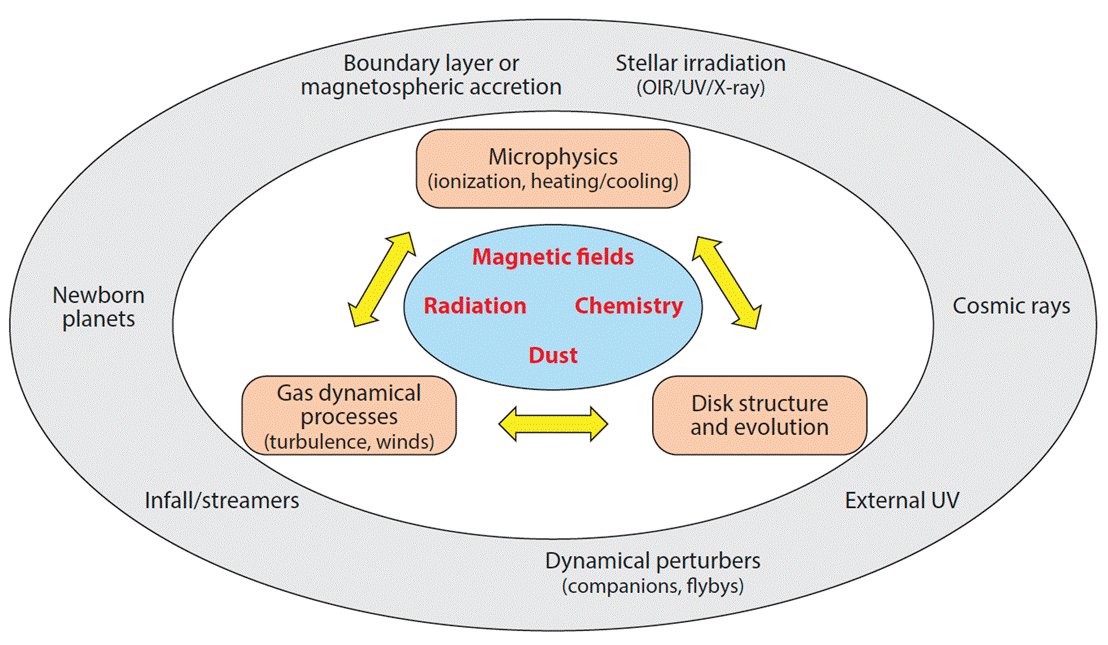
Figure 2: the protoplanetary disk ecosystem.
Prof. Bai concludes by proposing that protoplanetary disks can be considered an ecosystem in which a hierarchy of physical processes interact with each other and their star and planet formation environments through exchange of mass, angular momentum and energy (Figure 2). In the foreseeable future, systematic study of the protoplanetary disk ecosystem from first principles will become a promising research avenue poised to advance our knowledge in protoplanetary disks and planet formation.
The review article has been published online as Review in Advance on June 9th, 2026 in Annual Review of Astronomy and Astrophysics, titled “Angular Momentum Transport in Protoplanetary Disks”. Professor Xuening Bai is the single author of the article. This work is supported by National Science Foundation of China.
Link to the article:
https://www.annualreviews.org/content/journals/10.1146/annurev-astro-043024-115835
Author's version combining main text and supplement: http://arxiv.org/abs/2606.17150
Tsinghua University News: https://www.tsinghua.edu.cn/info/1175/126823.htm


