Introduction: On June 4, 2026, the journal Science published the paper "A stellar dynamical mass measurement of an inactive black hole at redshift 2," with Meng Gu, an assistant professor in the Department of Astronomy at Tsinghua University, as the 2nd author. Using James Webb Space Telescope (JWST) near-infrared integral field spectroscopy, together with the strong lensing magnification of a foreground galaxy cluster, the team made the first stellar dynamical measurement of an inactive supermassive black hole in the distant Universe, seen as it was some 10 billion years ago (redshift z = 1.95). The black hole has a mass about 6 billion solar masses. Remarkably, when the Universe was only about one quarter of its current age, this black hole was already consistent with the local scaling relation between black hole mass and stellar velocity dispersion, while being about 12 times more massive than expected from the local relation between black hole mass and bulge mass. This result provides a rare direct benchmark for testing how supermassive black holes and massive galaxies grew together across cosmic time.
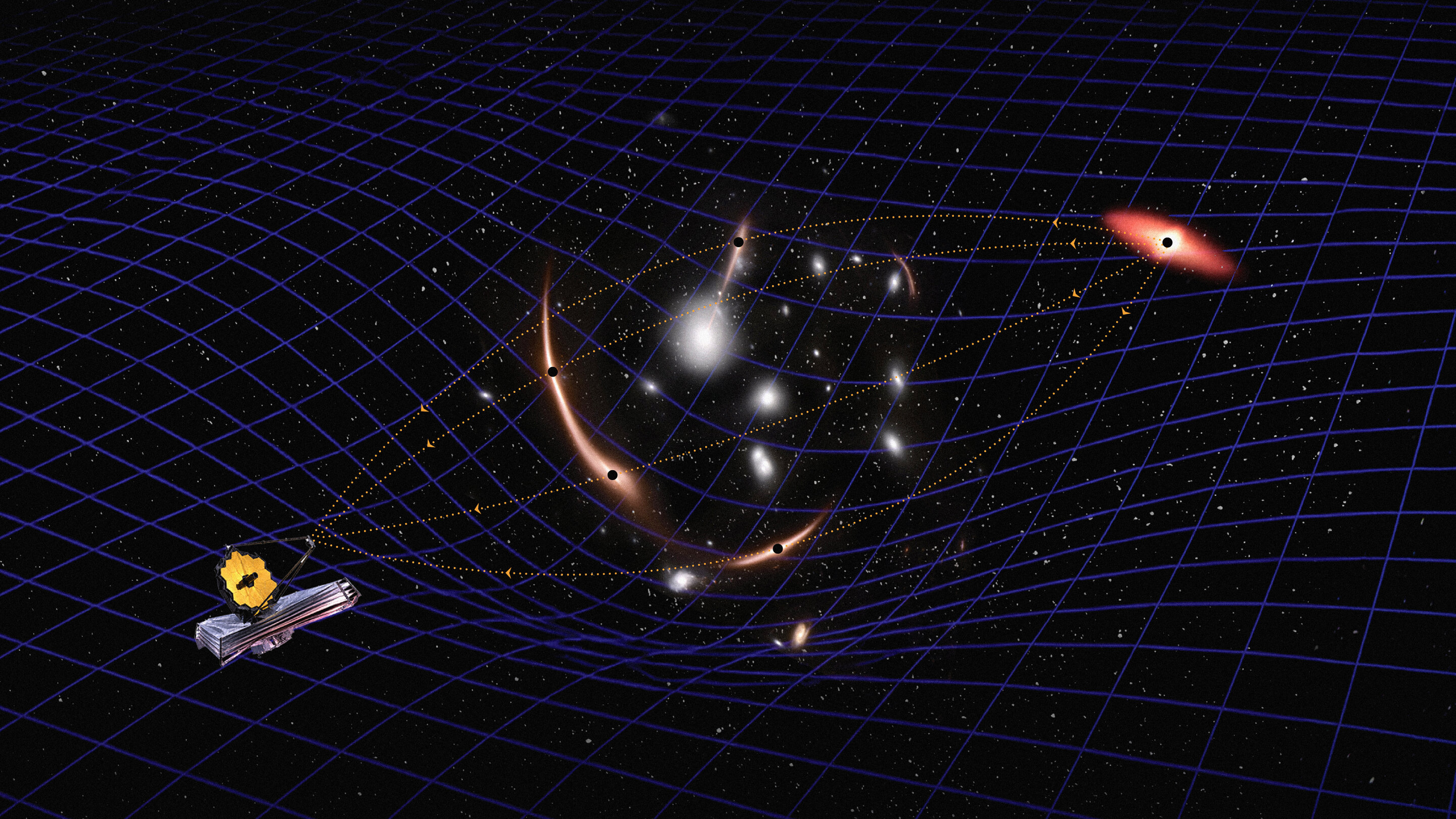
Artist's illustration: JWST and gravitational-lensing magnification enabled the team to measure the mass of an inactive black hole in the early Universe. Credit: Navid Marvi/Carnegie Science.
# Why is it so hard to weigh a distant black hole?
Observational astronomy has revealed that nearly every massive galaxy hosts a supermassive black hole at its center. Identifying these objects and measuring their masses remains a central problem in modern astrophysics.
In 2020, Reinhard Genzel and Andrea Ghez shared the Nobel Prize in Physics for decades of stellar-dynamical work showing that the center of the Milky Way contains a supermassive black hole of about four million solar masses. Beyond this individual discovery, astronomers have found that black hole masses correlate closely with key properties of their host galaxies, including bulge mass and stellar velocity dispersion. These empirical scaling relations are now a foundation for studying the coevolution of galaxies and their central black holes.
Yet the origin of these relations remains uncertain. Were they already in place in the early Universe? How have they evolved over the past 10 billion years? Answering these questions requires accurate black hole masses at large lookback times. Stellar dynamics is the cleanest way to measure a black hole mass because it uses the motions of stars orbiting in the black hole's gravitational potential. The difficulty is that the observations must resolve the black hole's sphere of influence, the small region where the black hole dominates stellar motions. Until now, this method has been limited almost entirely to nearby galaxies, typically within about 200 Mpc, or roughly 650 million light-years. At higher redshift, astronomers usually infer black hole masses indirectly from gas motions in bright active galactic nuclei (AGN), but those estimates carry strong selection effects and substantial systematic uncertainties. Measuring inactive black holes in the early Universe has therefore been a long-standing observational challenge.
# MRG-M0138: Gravitational Lensing and JWST Bring a Distant Black Hole Into View
To overcome this challenge, an international team led by Dr. Andrew Newman of Carnegie Science targeted MRG-M0138, a massive quiescent galaxy observed as it was about 10 billion years ago. Along our line of sight, MRG-M0138 lies behind the massive galaxy cluster MACS J0138.0-2155. The cluster acts as a natural telescope: its gravitational field magnifies MRG-M0138 by a factor of about 30 and stretches its light into multiple bright arcs. This rare alignment, combined with the sensitivity and spatially resolved spectroscopy of JWST/NIRSpec, made it possible to resolve the stellar kinematics inside the black hole's sphere of influence at a time when the Universe was only about one quarter of its present age.
The team analyzed the data with Jeans anisotropic dynamical models. These models included the stellar mass distribution, possible spatial variations in the stellar mass-to-light ratio, dark matter, galaxy inclination, velocity anisotropy, and a central black hole. Models without a black hole could not reproduce the observed central peak in the stellar second velocity moment. The best-fitting models imply a black hole mass of about 6 billion solar masses. The team also placed stringent limits on the black hole accretion rate: the inferred bolometric luminosity corresponds to an Eddington ratio below 10^-5.1. This confirms that the black hole is inactive, placing it beyond the reach of the usual indirect methods based on luminous AGN emission.
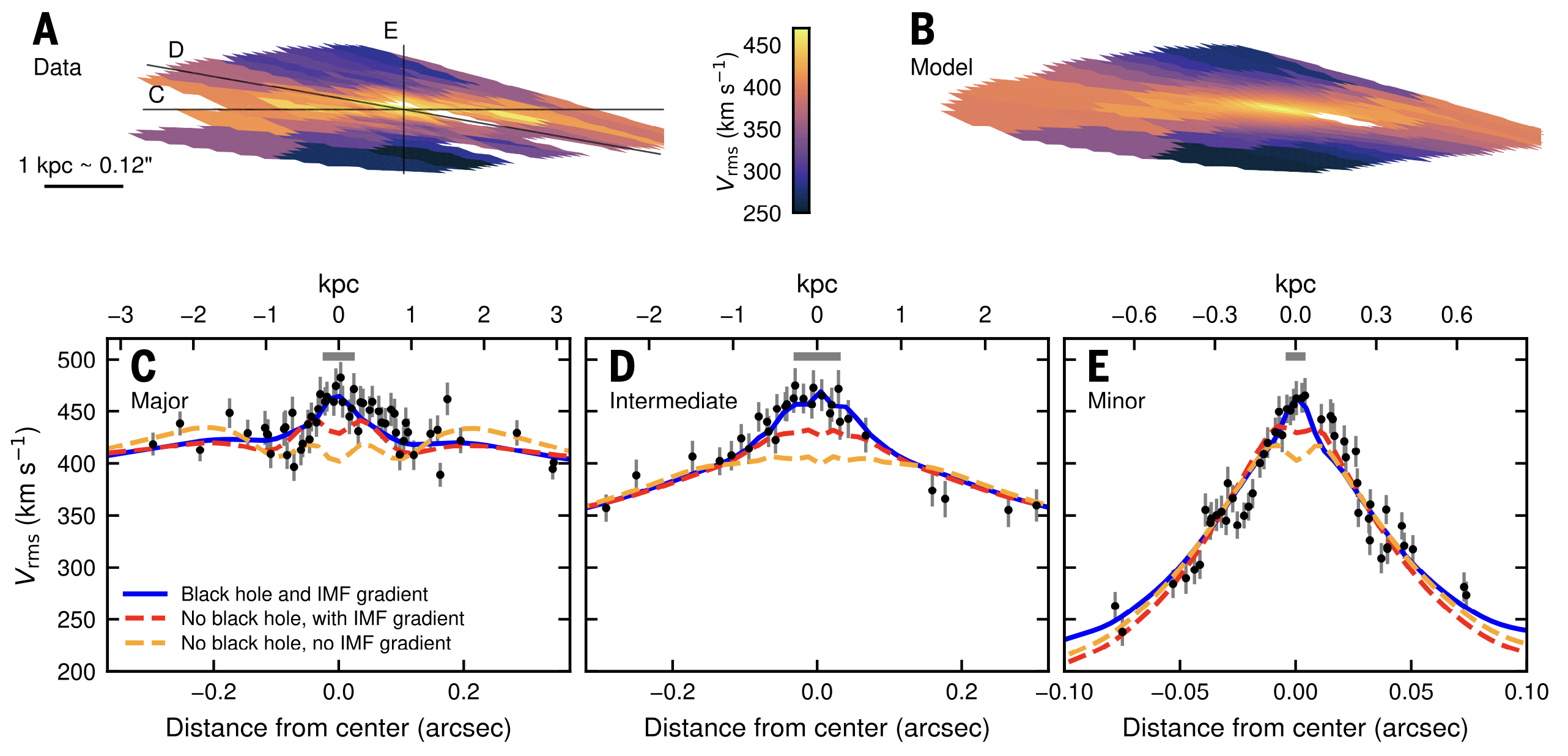
Stellar kinematics of MRG-M0138 compared with dynamical models. The prominent central peak in the stellar second velocity moment can only be reproduced when the model includes a black hole of about 6 billion solar masses; models without a black hole cannot explain the observations.
# An "Overmassive" Black Hole: Too Heavy for Its Bulge, Normal for Its Velocity Dispersion
The mass measurement revealed a striking result. Relative to its host galaxy's stellar velocity dispersion, the black hole in MRG-M0138 is consistent with the relation observed in nearby galaxies. Relative to the stellar mass of its bulge, however, the black hole is about 12 times more massive than expected from the local black hole-bulge mass relation.
This contrast suggests that the black hole mass-stellar velocity dispersion relation may have been established earlier than the black hole mass-bulge mass relation. One possible interpretation is that the bulge continues to grow after the main epoch of black hole growth. Between redshift z=2 and the present day, MRG-M0138 is expected to roughly double its stellar mass, primarily through mergers. If those later mergers are gas-poor, they would add stars while producing little additional black hole growth and only modest changes in stellar velocity dispersion. Such evolution would move MRG-M0138 toward the local black hole-bulge mass relation and could produce black hole and stellar masses similar to those of the nearby giant elliptical galaxy M87.
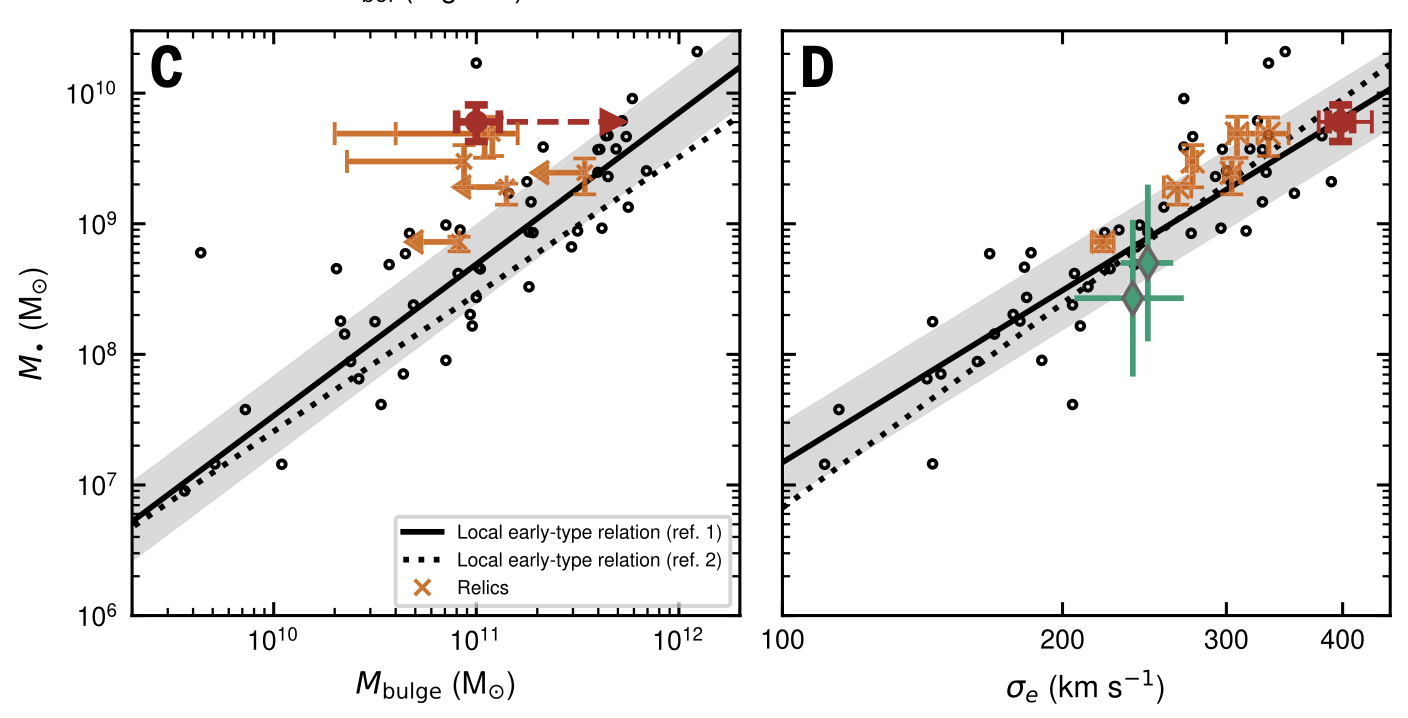
In the relation between black hole mass and stellar velocity dispersion, MRG-M0138 looks similar to nearby galaxies. However, when compared with the bulge mass, its black hole appears unusually overmassive, about 12 times more massive than expected from the local black hole-bulge mass relation.
The result also connects MRG-M0138 to a rare class of nearby "relic galaxies," thought to be descendants of galaxies that stopped forming stars at redshift greater than about 2 and then avoided major mergers. Like MRG-M0138, these relic systems are outliers in the black hole mass-bulge mass relation but remain consistent with the black hole mass-velocity dispersion relation. The structural and kinematic resemblance between MRG-M0138 and local relic galaxies supports the interpretation that relic galaxies are undisturbed descendants of early quiescent galaxies.
The study, titled "A stellar dynamical mass measurement of an inactive black hole at redshift 2," was published in Science. Andrew B. Newman of Carnegie Science is the first and corresponding author. Assistant Professor Meng Gu of the Department of Astronomy at Tsinghua University is the second author. Original article: https://www.science.org/doi/epdf/10.1126/science.adx5816


