In a recent study led by the Department of Astronomy, Tsinghua University, a group of astronomers explained the silicate cloud features on a super-puff planet WASP-107 b with a self-consistent atmosphere model.
The James Webb Space Telescope (JWST) opens up a new window to study the composition of exoplanet atmospheres. Benefiting from its broad wavelength coverage and extraordinary signal-to-noise ratio, astronomers are measuring the elemental abundances of exoplanet atmospheres with unprecedented precision, revealing signs for exoplanet habitability and formation histories.
Among the planets observed by JWST, Neptune-mass WASP-107 b has intrigued astronomers. Its Jupiter-large radius magnifies its spectral features, making it one of the best observed planets by JWST. Recent observations have revealed the presence of SO2, an indicator for photochemistry, and the absence of CH4, implying that the upper atmosphere of WASP-107 b is in chemical disequilibrium. In particular, JWST/MIRI has detected the presence of silicate cloud particles in its atmosphere. However, such clouds are theoretically expected to rain out into the deep interior of this relatively cool planet (equilibrium temperature ~750 K), leaving the mechanism behind the detected silicate features a mystery.
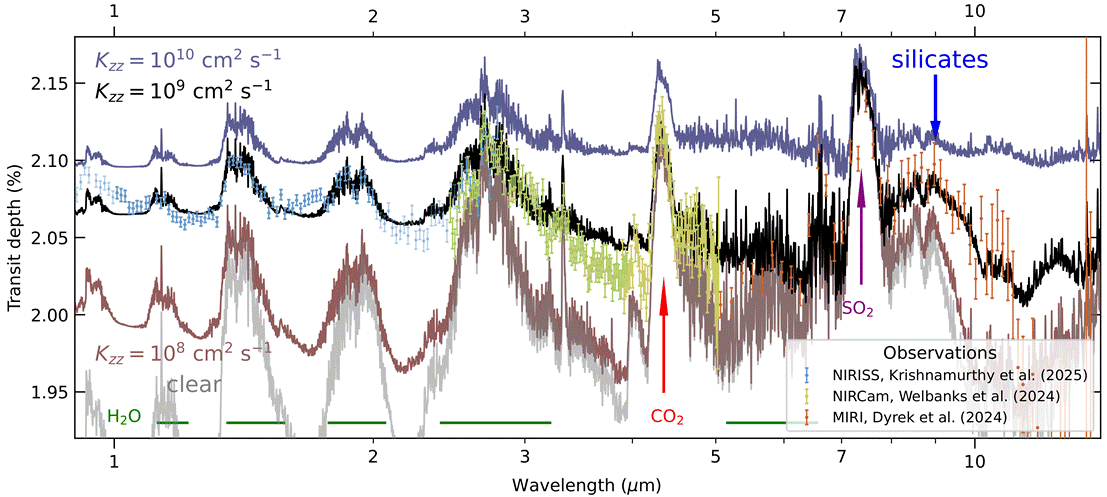
Simulated JWST transmission spectra of WASP-107 b. The observational data (points with error bars) of different JWST instruments (color) are compared with simulations of different turbulence values (Kzz; solid lines). The Kzz=109cm2s-1 model provides the best fit, explaining the entire spectrum from near-IR molecular bands to mid-IR silicate features.
In the latest study led by the Department of Astronomy, a team of astronomers modeled the complete JWST spectrum of WASP-107 b from 1 to 10 micron self-consistently. Combining radiative transfer and the in-house developed cloud formation model ExoLyn, the formation and transport mechanism of the silicate clouds on WASP-107 b is understood for the first time. It is found that silicates can condense in the atmosphere and, under a moderate turbulence level (Kzz=1e9), be transported to visible layers. The model successfully fit the near-infrared and mid-infrared spectra of the planet. In particular, the role of clouds is manifested through the suppression of the near-IR molecular features and an appearance of a characteristic 8-10 um silicate ”bump”.
With the self-consistent model, this study discovered that the atmosphere of WASP-107 b is characterized by a metallicity of 17x solar and a high internal heating flux. The strong heating, potentially driven by tidal heating or Ohmic dissipation, helps explain the large radius of WASP-107 b.
Accepted to Astronomy and Astrophysics Letters, this study is led by Helong Huang, a fourth-year a fourth-year PhD student from the Department of Astronomy, Tsinghua University. Other coauthors include Dr. Michiel Min from SRON, Prof. Chris Ormel from DoA, Tsinghua University, Dr. Achrène Dyrek from STScI and Dr. Nicolas Crouzet from Leiden Univerisity.
Paper Link: https://www.aanda.org/articles/aa/full_html/2026/04/aa58447-25/aa58447-25.html


