On April 8, 2026, a collaborative team from the Xinjiang Astronomical Observatory (XAO) of the Chinese Academy of Sciences, Tsinghua University, and the National Astronomical Observatories of the Chinese Academy of Sciences (NAOC) reported a major new result in Nature Astronomy. Through the CRAFTS survey with the Five-hundred-meter Aperture Spherical radio Telescope (FAST), the team discovered a peculiar millisecond pulsar (MSP), PSR J0435+3233. Follow-up high-precision timing observations have now revealed its remarkable physical nature.
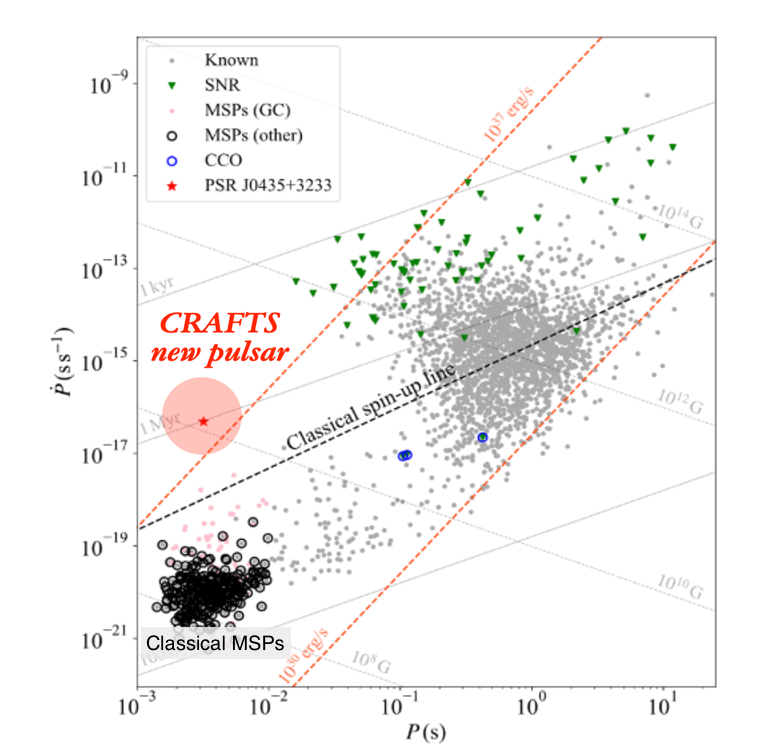
Figure 1. Period–period derivative diagram of known pulsars and the newly discovered pulsar PSR J0435+3233, highlighting the striking contrast in period derivative between PSR J0435+3233 and classical millisecond pulsars.
PSR J0435+3233 has a spin period of 3.2 milliseconds, yet its period derivative, 4.88×10⁻¹⁷ ss-1, is 100 times larger than those of most known millisecond pulsars in the Milky Way, corresponding to a spin-down timescale of just 1 million years. In other words, this MSP is undergoing an unusually rapid spin-down, or “sudden braking”. On the period--period derivative diagram, a fundamental diagnostic tool for pulsar evolution, the source lies above the conventional “Eddington spin-up line” predicted by standard theory. This placement indicates that its surface magnetic field is roughly 100 times stronger than that of typical MSPs. The researchers suggest that such an unusual object may have formed through an atypical evolutionary pathway, potentially involving super-Eddington accretion onto a strongly magnetized neutron star or the accretion-induced collapse of a magnetized white dwarf, rather than the canonical recycling channel for MSPs.
PSR J0435+3233 was first identified through the Commensal Radio Astronomy FasT Survey (CRAFTS), a survey led by Prof. Di Li’s group at Tsinghua University and NAOC. After its discovery, PSR J0435+3233 was closely followed up under the FAST Key Project on Pulsar Timing, led by XAO, ultimately enabling the team to determine its key physical properties, including its exceptionally large spin-down rate and unusually strong surface magnetic field. Since starting operations in 2020, CRAFTS has completed about 30% of its planned sky coverage and discovered more than 220 new pulsars, including rare systems such as double neutron star binaries. Data products from the survey, including pulsar catalogs, HI data cubes, and calibration pipelines, are publicly available through the ScienceDB-CRAFTS and HIverse platforms.
The first author of the study is Qingdong Wu, a graduate student at XAO. The corresponding authors are Dr. Na Wang and Dr. Jianping Yuan of XAO, Prof. Guoliang Lü of Xinjiang University, and Prof. Di Li of Tsinghua University. The article is available at: https://www.nature.com/articles/s41550-026-02836-3


