A research team led by Tsinghua University and the Institute for Advanced Theoretical Physics has revealed how black holes can exhibit turbulence-like phenomena similar to those found in fluids. Introducing a novel numerical relativity technique, the team was able to simulate gravitational waves directed into a black hole and observe its response. This approach enables a deeper understanding of the complex nonlinear features of general relativity in extreme environments.
Turbulence is a common phenomenon in fluids. It can be observed in small laboratory beakers containing stirred reagents, as well as in large-scale oceanic hurricanes. The essence of turbulence lies in nonlinear interactions within the fluid, which transfers energy and other conserved quantities across larger or smaller length scales.
Why, then, would black holes also exhibit turbulence? This reflects an equivalence that appears in many areas of physics: systems that seem entirely unrelated can share remarkably similar fundamental properties. For example, a mass attached to a spring and an LC electrical circuit can both be described by a harmonic oscillator. Similarly, the theory describing phase transitions in condensed matter systems (i.e. the transition at the Curie temperature for ferromagnetic metals) is, to a large extent, also applicable to gravitational critical collapse systems with scalar field. Once such correspondences—simple or complex—are uncovered, they often greatly deepen our understanding of the systems involved and open the door to new discoveries.
In a 2015 study published in Physical Review Letters (https://journals.aps.org/prl/abstract/10.1103/PhysRevLett.114.081101), some of the authors of the present work had already identified that BH systems manifest a particular kind instability, the so-called parametric instabilities, which often play a key role in fluid turbulence. However, due to limitations in theoretical and numerical techniques at the time, it was not possible to demonstrate black hole turbulence through full numerical relativity simulations. Specifically, to study turbulence, an external energy injection source is typically required to sustain the system for an extended period—something that had long posed a technical challenge in black hole studies.
In this new work, the research team has developed improved boundary treatment methods for numerical relativity simulations. This made it possible to simulate injection of gravitational waves into a black hole in a long-term, stable manner and to precisely track the spacetime evolution. The team found that when the amplitude of the injected gravitational waves is small, the black hole’s response resembles that of laminar flows in fluids, with low momentum convection. Conversely, when the amplitude exceeds a certain critical value, nonlinear instabilities—including parametric-like instabilities—are triggered, and the spacetime excitations clearly show a tendency to cascade toward longer wavelengths. This behavior bears a striking resemblance to that seen in turbulent, two-dimensional fluids. With this new numerical experimental platform, black hole turbulence is expected to be characterized in a more quantitative and precise way.
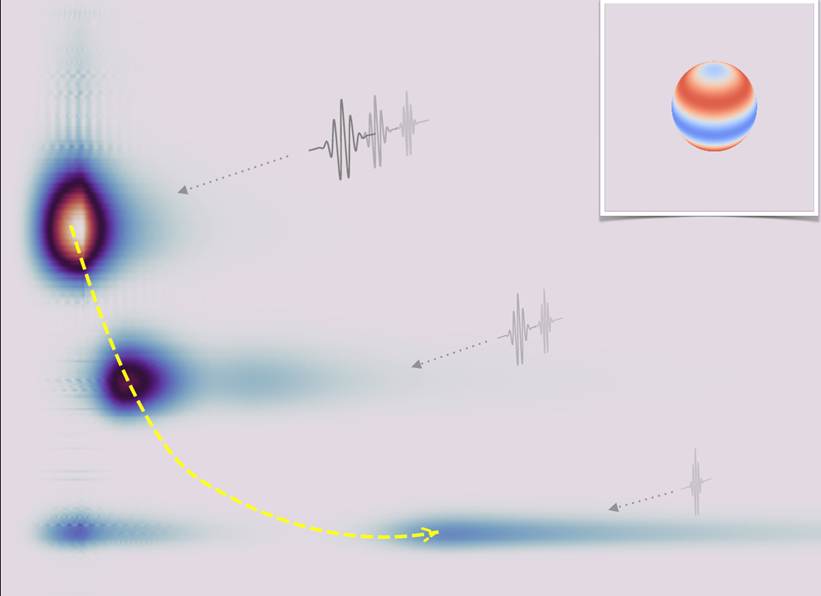
Figure 1: The excitations of the black hole shift toward longer wavelengths or lower spatial frequencies (vertical axis) as time (horizontal axis) increases.
The study, titled “Turbulence in Nonlinear Gravity,” was published in Physical Review Letters. The first author is Dr. Sizheng Ma from the Institute for Advanced Theoretical Physics, and the corresponding author is Prof. Huan Yang from the Department of Astronomy at Tsinghua University. The work was carried out in collaboration with researchers from California Institute of Technology, Cornell University, and Max Planck Institute for Gravitational Physics.
Article link: https://journals.aps.org/prl/abstract/10.1103/c9m4-mj3t


