Prof. Di Li’s team at Tsinghua University, in collaboration with scientists from Central China Normal University, Yunnan University, and the National Astronomical Observatories of the Chinese Academy of Sciences, conducted a systematic, multi-year monitoring survey of a fast radio burst using China’s Five-hundred-meter Aperture Spherical radio Telescope (FAST). For the first time, they witnessed the year-to-year evolution of the target, demonstrating that it is born in a young supernova remnant.
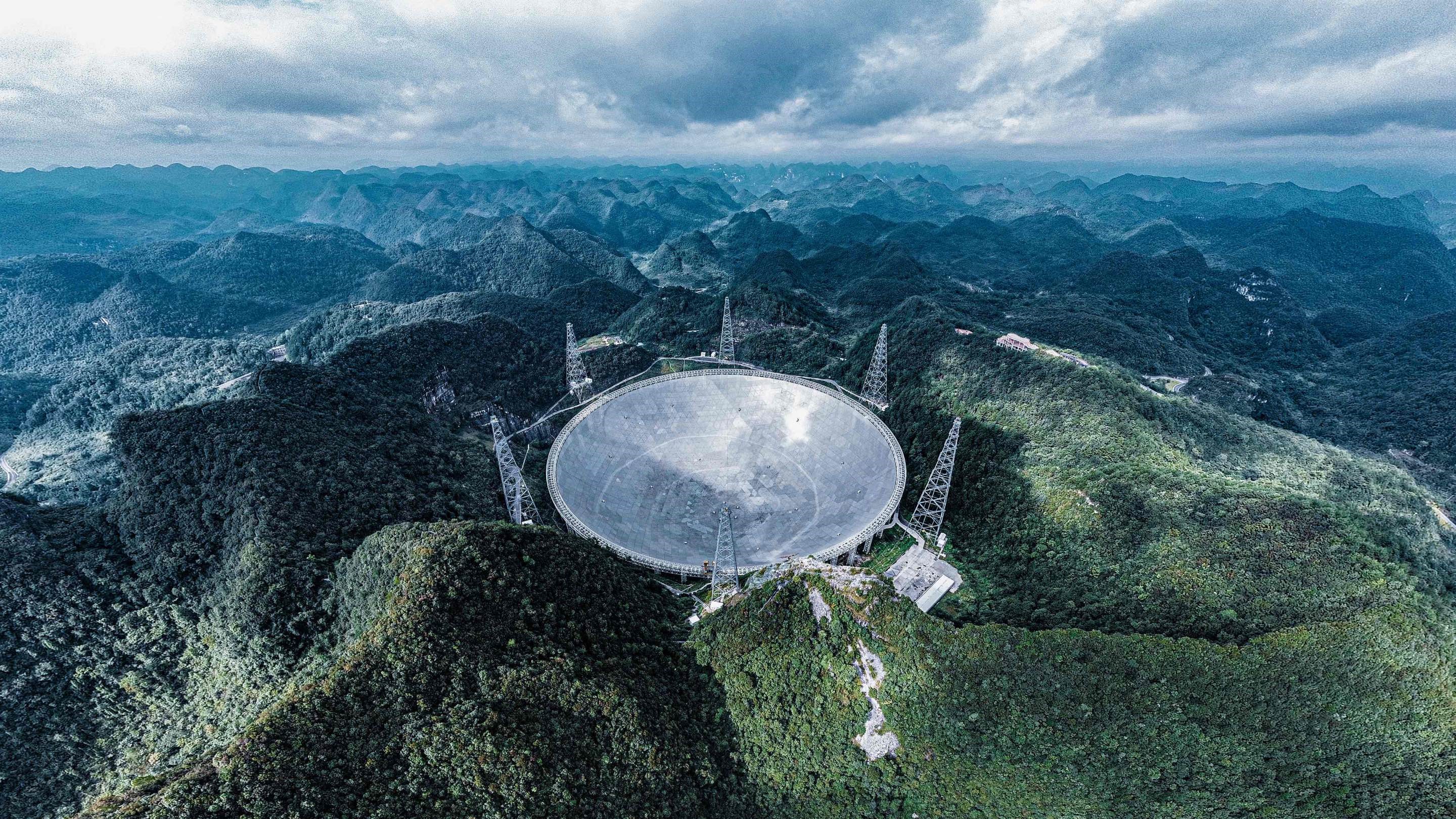
Figure: An aerial view of the FAST telescope.
Fast radio bursts (FRBs) are millisecond-duration, highly energetic eruptions from the distant universe, capable of releasing in an instant as much energy as the Sun emits over an entire year. Most FRBs are observed only once and then fall silent, or remain dormant for long periods, which greatly limits scientists’ ability to study their surrounding environments. The Commensal Radio Astronomy FAST Survey, a key program of FAST led by Prof. Di Li, discovered the world’s first persistently active FRB in 2019, later designated FRB 20190520B.
Over the ensuing four years, a team led by Niu Chenhui, a professor from Central China Normal University, conducted follow-up observations of FRB 20190520B using FAST, confirming it is the only FRB known to remain active across multiple years. This unprecedented stable activity provides a valuable "natural laboratory" for studying the evolution and origin of FRBs.

Figure: Long-term monitoring of FRB 20190520B by FAST. The picture depicts the magnetar as the FRB’s central engine and its complex plasma environment due to the supernova explosion.
The researchers systematically analyzed over 400 bursts from this source and found that a key parameter, the Dispersion Measure (DM), of FRB 20190520B exhibited a steady and unusually rapid decrease over these four years, indicating that the FRB signals are traveling through a dense environment that is expanding and thinning over time. The observations strongly imply that the burst engine is a young magnetar, a type of neutron star with the strongest magnetic field in the universe, embedded within a supernova remnant. As the supernova shell expands, the plasma density decreases, naturally leading to the observed sustained decline in DM. The team's model indicates the observed signals originate from a remnant only 10 to 100 years old after the supernova explosion, making it an "extremely young" remnant on cosmic timescales.
Prof. Conner of Harvard, one of earliest proponents of the supernova origin of FRBs, expressed his excitement about this new result in the communication to Science Bulletin editor: This work provides the most compelling evidence to date that the birth sites of some FRBs are indeed the death sites of their massive parent star. The new result provides an exciting hint at the mysterious origin of at least a sub-class of repeating fast radio bursts.
Paper link:
https://www.sciencedirect.com/science/article/pii/S209592732501151X


