Credit: AI Doubao
A new study published in The Astronomical Journal (AJ) reports the discovery of a previously unrecognized degeneracy in microlensing two-planet systems, highlighting the need for caution when interpreting complex planetary signals in future space-based microlensing surveys.
The two planets were discovered through the microlensing event KMT-2022-BLG-1818, with the planetary signals primarily detected by a microlensing key project of the Las Cumbres Observatory, in which the Department of Astronomy at Tsinghua University has a major contribution. Gravitational microlensing, which detects the temporary brightening of a distant background star caused by the gravitational field of a foreground lens, is particularly sensitive to planets in the lens system that orbit their host star at Jupiter-like distances.
The planetary system is hosted by a K-type dwarf star located in the Galactic disk. The complex shape of the light curve (see Figure) indicates the system hosts two planets. The first planet is more massive than Jupiter and admits two degenerate orbital solutions, one interior and one exterior to the Einstein ring, corresponding to the well-known close–wide degeneracy. Both solutions place the planet at orbital separations comparable to that of Jupiter in the Solar System. Remarkably, the inferred mass of the second planet differs by up a factor 10 between these two configurations. This behavior is fundamentally different from previously known microlensing two-planet systems, in which the mass of the second planet remains nearly identical under different orbital solutions of the first planet. Due to the close–wide degeneracy, the second planet admits two possible orbital solutions, corresponding to either a wider orbit at a separation comparable to Saturn’s orbital radius or a closer-in orbit at a separation comparable to that of Mercury.
In this system, the signal from the first planet is significantly stronger than that of the second planet. As a result, even small modifications to the model of the primary planet can lead to large changes in the inferred physical parameters of the second planet, in contrast to previously studied systems where the two planetary signals had comparable strengths.
In the coming years, space-based microlensing missions,including the Nancy Grace Roman Space Telescope, the Chinese Space Station Telescope (CSST), and the Chinese Earth 2.0 Microlensing Telescope, are expected to discover thousands of new exoplanets with the microlensing method. The new study highlights a new type of degeneracy in microlensing two-planet systems and may point to previously unexplored aspects of gravitational lensing physics. It underscores the importance of careful and comprehensive analyses of complex microlensing systems in the era of large microlensing datasets.
The study was published on December 17, 2025, in The Astronomical Journal. Department of Astronomy PhD students Hongyu Li and Jiyuan Zhang are co-first authors. Other Tsinghua contributors include Prof. Wei Zhu, PhD students Yunyi Tang and Qiyue Qian, and former Tsinghua PhD students Weicheng Zang, Renkun Kuang, and Hongjing Yang. In addition, the KMTNet, OGLE, MOA, and uFUN collaborations contributed data essential for the planet characterization.
This research was supported by a Key Project of the National Natural Science Foundation of China.
Paper Link: https://doi.org/10.3847/1538-3881/ae1b8f
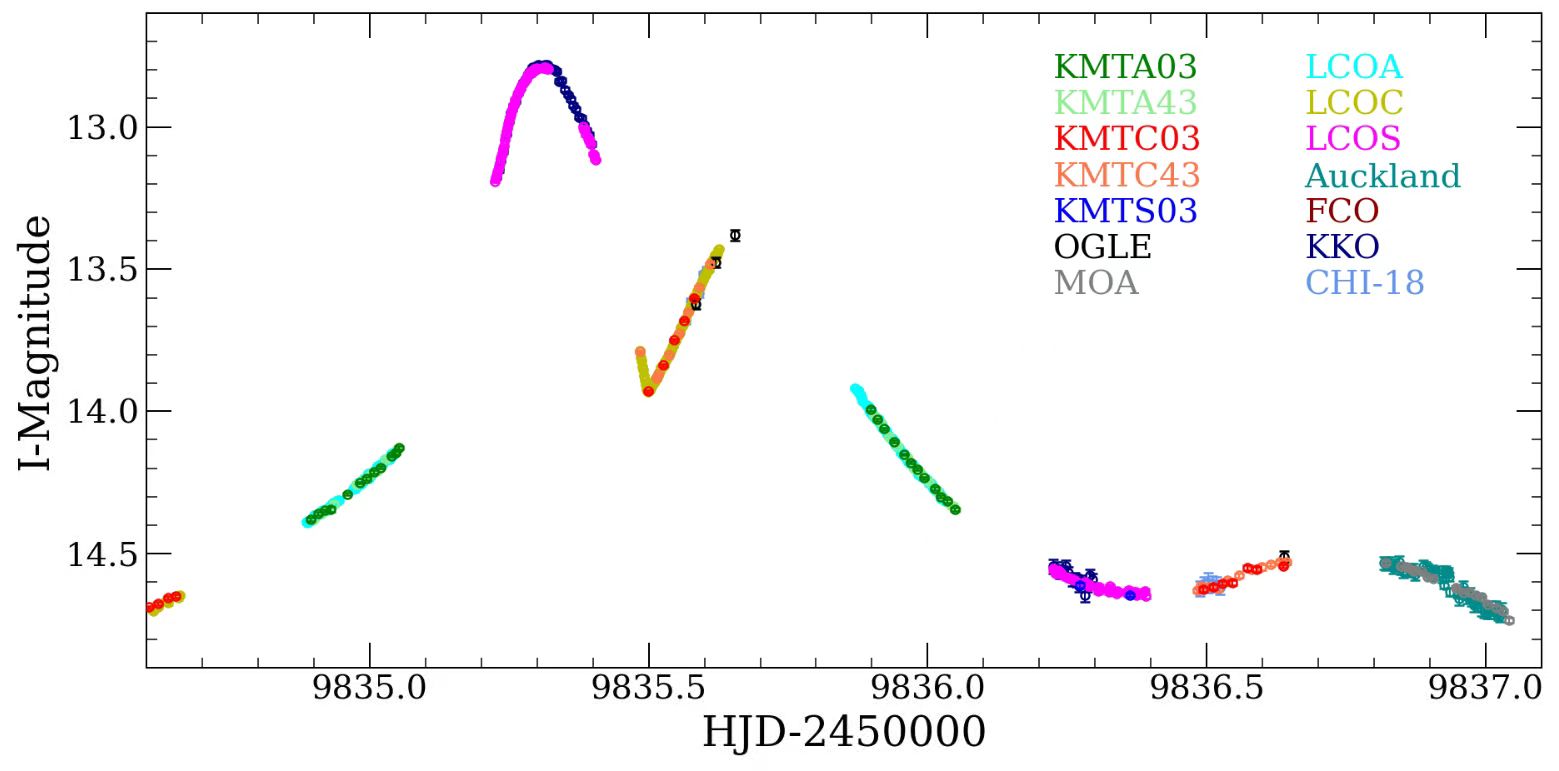
Caption: Peak light curve of the microlensing event KMT-2022-BLG-1818. The different colored points represent data from the various observing facilities indicated in the legend. The light curve exhibits three distinct bumps produced by the two orbiting planets. The first two peaks were primarily observed by the Las Cumbres Observatory network, in which Tsinghua University plays a major role.


