Abstract: An international research team led by the Department of Astronomy at Tsinghua University has successfully identified 23 of the most luminous dust-obscured quasars (Type-2 QSOs) from the 'cosmic noon' (2 to 3 billion years after the Big Bang corresponding to redshift z = 0.88–3.49), using spectroscopic observations from the world's most advanced ground-based telescopes, Keck and Gemini. The team selected candidates using photometric data from the Dark Energy Spectroscopic Instrument (DESI) Legacy Survey and the Wide-field Infrared Survey Explorer (WISE), successfully filling a niche for selecting obscured quasars. The study found that more than one-third of these obscured black holes, expected to emit only 'narrow' spectral lines, surprisingly exhibited 'broad' emission line features typical of normal quasars. Furthermore, the spectral energy distributions and spectroscopic characteristics of these obscured quasars bear a striking resemblance to the 'Little Red Dots' (LRDs) recently discovered by JWST. These provide clues for understanding key questions about the growth history of supermassive black holes in the early universe and the population of quasars. .
The Unknown Supermassive Black Holes: Searching for Obscured Quasars at Cosmic Noon
Quasars are the brightest objects in the universe, powered by the accretion of matter onto supermassive black holes at the centers of galaxies. According to the classical unified model, if the observer's line of sight is blocked by a dusty torus, only narrow emission lines are visible; such objects are called 'obscured' (Type-2) quasars. Conversely, if both broad emission lines and continuum emission is observed, they are termed 'unobscured' (Type-1) quasars. However, obscured quasars are very faint at visible wavelengths, making a complete census and understanding of their physical nature challenging, especially at high redshifts.
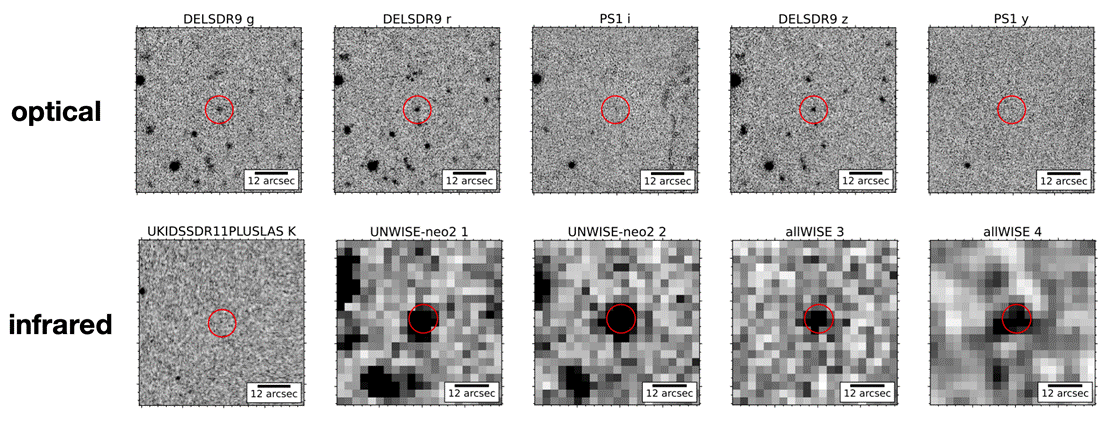
Figure 1: Photometric images of an obscured quasar candidate, spanning from optical to infrared wavelengths. This candidate was selected using the "infrared-bright, optically-faint, or extremely red" selection criteria.
To fill the gap in unbiased selection methods for obscured quasars, the research team utilized photometric data from the DESI Legacy Survey and WISE. Applying a selection criterion of 'infrared-bright, optically-faint or extremely red', they successfully identified 24 candidate objects. Subsequent detailed spectroscopic observations using the powerful Keck and Gemini telescopes confirmed 23 out of the 24 candidates as obscured quasars, with redshifts spanning z = 0.88–3.49, achieving a remarkable success rate of 96%. Importantly, 12 of these quasars reside at redshifts z > 2, significantly enriching the sample of obscured quasars from the 'cosmic noon' epoch.
Spectroscopic Diversity Challenging Conventions: Obscured Quasars with Broad Lines
According to the classical unified model for Active Galactic Nuclei, the observer's viewing angle is the primary factor determining whether we see an 'exposed' broad-line quasar (Type1 QSOs) or a 'hidden' narrow-line one(Type2 QSOs). However, the obscured quasars discovered in this study exhibit complex diversity in their spectral features: approximately one-third (8 objects) show broad hydrogen emission lines in the near-infrared band with widths exceeding 2000 km/s, a feature typically only seen in 'exposed' quasars. This discovery indicates that black hole growth is more diverse than previously thought, and the distinction between Type 1 and Type 2 QSOs may not be fully explained by the classical model.
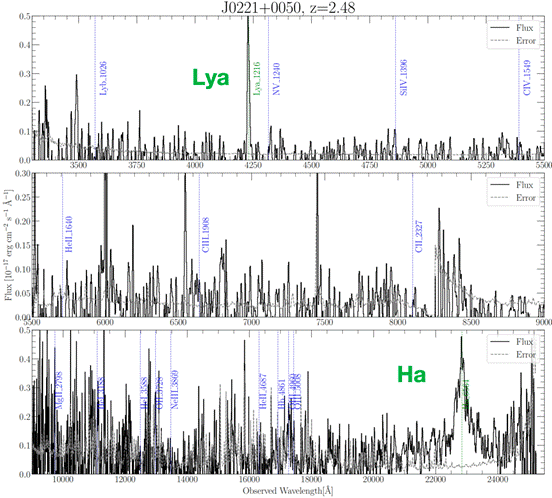
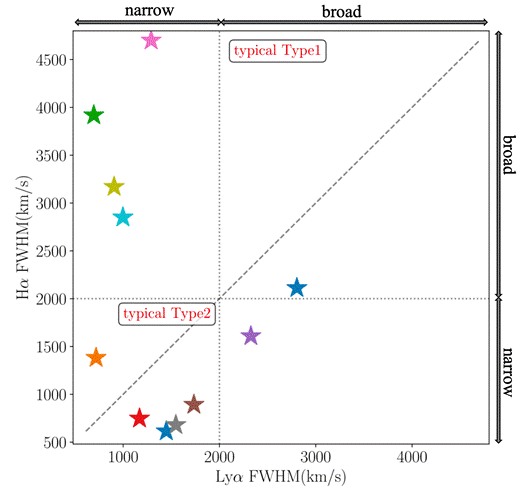
Figure 2: Left: Keck and Gemini spectra of an obscured quasar exhibiting the peculiar combination of "broad Hα but narrow Lyα" emission lines. Right: The obscured quasars discovered in this study show a remarkable diversity in the distribution of their emission line widths.
Building a Bridge: Connecting the Low-Redshift Universe to JWST's New Discoveries
JWST has recently uncovered a new and large population of high-redshift 'Little Red Dots' (LRDs) at z > 4 in the early universe. The physical nature of these LRDs is hotly debated. Studies of the Spectral Energy Distributions (SEDs) of the obscured quasars in this research reveal that their UV and optical SEDs and their broad emission line features show similarities to those of the LRDs. The obscured quasars discovered in this study are situated precisely at the 'cosmic noon' epoch, around z ~ 2-3. They therefore act as a bridge, connecting the known obscured quasars at low redshift (z < 1) with the mysterious LRDs discovered by JWST at much higher redshift. This indicates that the universe during its middle age also hosted a large, previously unrecognized population of obscured black hole growth with complex structures. In-depth study of these objects will advance our understanding of the nature of JWST's newfound sources and map the growth history of supermassive black holes throughout cosmic time.
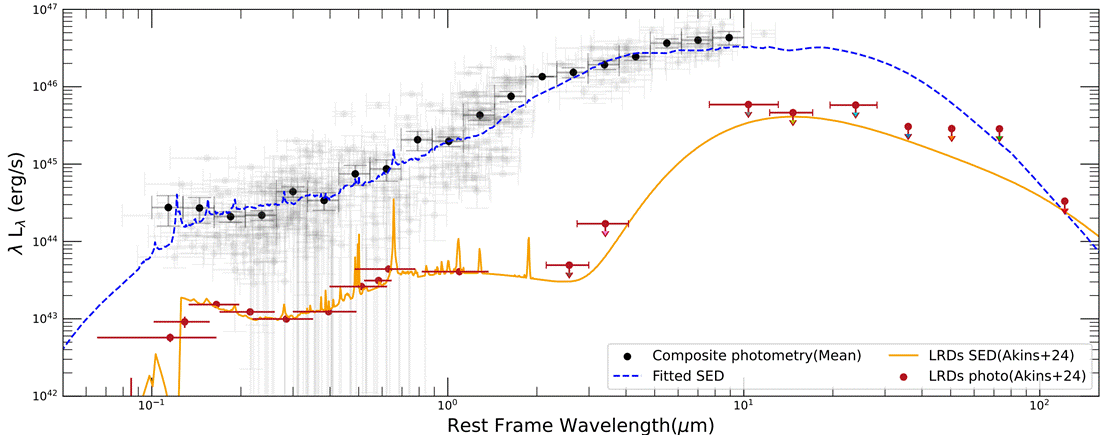
Figure 3: Spectral energy distribution (SED) fitting for the obscured quasars discovered in this study (black data points and blue curve) reveals that their light originates from the central supermassive black hole, the host galaxy, and a hot dust torus. Furthermore, the shape of these quasars' UV/optical SEDs is strikingly similar to that of the high-redshift 'Little Red Dots' recently discovered by JWST.
Publication Information and Acknowledgments
This series of research findings is published under the theme "Luminous mid-IR selected obscured quasars at cosmic noon in SDSS Stripe82" in two parts in the *Monthly Notices of the Royal Astronomical Society (MNRAS)*. Part I, "Selection, composite photometry, and spectral energy distributions," was published in April 2025. Part II, "Spectroscopic diversity and broad Hα emissions," was published in October 2025.
Ben Wang, a joint PhD student of the Department of Astronomy at Tsinghua University and Leiden Observatory, is the first author and corresponding author of the series. Professor Zheng Cai from the Department of Astronomy at Tsinghua University and professor Joseph Hennawi from Leiden Observatory are co-authors. Collaborating institutions include Leiden Observatory (the Netherlands), University of California Santa Barbara, MIT, Drexel University, Johns Hopkins University, the Institute for Advanced Study in Princeton, Hamburg Observatory,. This work was supported by National Key R&D Program of China, the National Science Foundation of China, the science research grants from the China Manned Space Project, and Tsinghua University Initiative Scientific Research Program.


